
News
Commonwealth financial transparency strengthened as Sri Lanka moves to protect unit trust investors


Sri Lanka is set to enhance financial transparency and investor protection within the Commonwealth framework through proposed amendments to its Inland Revenue Act, according to the Unit Trust Association of Sri Lanka (UTASL).
The proposed reforms are designed to improve accountability and governance in the country’s growing investment sector, ensuring that unit trust investors receive clearer and more detailed financial information. Under the draft legislation, unit trusts will be required to issue comprehensive income certificates outlining investor earnings, tax exemptions, withholding taxes and other relevant financial details as specified by the Commissioner General of Inland Revenue.
The certificates must be provided within five months after the end of each assessment year, allowing investors to better manage tax compliance and financial planning.
Tax experts say the reforms will align Sri Lanka’s financial reporting practices with international standards observed across many Commonwealth economies. The measures are also expected to strengthen investor confidence and improve regulatory oversight within the sector.
According to EY Sri Lanka Partner Tax Shehani Paranavitane, unit trusts that fail to issue the required certificates could be taxed as corporate entities, creating a strong incentive for compliance.
The proposed amendments are scheduled to take effect from April 1, 2025. Financial analysts believe the move represents an important step toward modernising Sri Lanka’s investment environment and reinforcing good governance practices consistent with Commonwealth financial principles.

Explainers
Open Banking vs Card Payments: Which Is Better for Small Businesses?
UK open banking has passed one billion payments. Should small businesses switch from cards to “pay by bank”? A clear comparison of cost, speed, protection and customer experience.


In short: Open banking payments (“pay by bank”) move money directly from a customer’s bank account, often at lower cost and with near-instant settlement. Cards remain more familiar and offer customers chargeback protection. For most small businesses the answer is both: cards for everyday sales, open banking for larger, recurring or invoice payments.
Open banking has moved from experiment to infrastructure. In July 2026, Open Banking Limited announced that UK open banking had passed one billion payments, with more than 40 million payments in June 2026 alone. Variable recurring payments — which let customers authorise ongoing payments from their bank — grew 6.7% in a single month.
How does open banking payment work?
At checkout, the customer chooses “pay by bank”, selects their bank and approves the payment in their banking app, usually with a fingerprint or face ID. The money moves over the Faster Payments network directly into the business’s account. No card details are entered or stored.
How do open banking and cards compare?
| Card payments | Open banking (pay by bank) | |
|---|---|---|
| Cost to business | Interchange, scheme fees and provider margin | Often a lower flat fee per transaction |
| Settlement | Typically one or more working days | Usually near-instant |
| Customer protection | Chargeback rights | No card-style chargeback |
| Fraud exposure | Card-not-present fraud risk | Strong bank authentication; no card data |
| Customer familiarity | Very high | Growing quickly |
| Recurring payments | Stored cards | Variable recurring payments |
When does open banking make most sense?
- Higher-value payments, where percentage-based card fees become expensive
- Invoices and B2B payments, where a payment link is faster than manual bank transfer
- Subscriptions and memberships, using variable recurring payments
- Cash-flow sensitive businesses that benefit from instant settlement
Where did UK open banking come from?
Open banking in the UK was not a purely commercial invention. It was created after a Competition and Markets Authority investigation into retail banking concluded that competition needed a boost. The CMA required the nine largest current account providers — often called the “CMA9” — to open up secure access to customer accounts through standardised technology interfaces (APIs), with the customer’s consent. The service went live in January 2018, alongside the EU’s second Payment Services Directive, which introduced similar rights across Europe.
Pay-by-bank payments run on the UK’s Faster Payments system, launched in 2008, which is why money usually arrives within seconds rather than days.
What are the practical drawbacks?
Open banking is not a perfect substitute for cards, and it is worth being clear about the trade-offs:
- Refunds are not automatic in the way card refunds are. Businesses need a process to send money back, usually by bank transfer.
- Customer habit still favours cards and digital wallets. A pay-by-bank button that customers do not notice or trust will not be used.
- Payment limits set by individual banks can affect very large payments.
- In-person use is less developed than online. Some providers offer QR-code payments at the till, but contactless cards and phones remain the norm in shops.
How can a small business get started?
- Ask your current provider. Many card acquirers and e-commerce platforms now offer pay by bank as an add-on, so you may not need a new contract.
- Check authorisation. Open banking payments are initiated by firms authorised or registered by the Financial Conduct Authority as payment initiation service providers. The FCA register shows who is permitted.
- Start where it matters most. Add pay by bank to invoices or high-value orders first, and measure take-up before rolling it out everywhere.
- Explain it to customers. A short line such as “Pay securely through your banking app” increases confidence.
The bottom line
This is not cards versus open banking — it is about offering the right method for the right moment. Businesses that give customers choice, and steer larger or repeat payments towards pay by bank, can cut costs and improve cash flow without losing sales.
Frequently asked questions
Is open banking safe for businesses?
Yes. Customers approve each payment inside their own banking app with strong authentication, and no card details are shared with the business.
How many open banking payments are made in the UK?
Open Banking Limited reported in July 2026 that UK open banking had passed one billion payments, with more than 40 million payments made in June 2026.
Do open banking payments have chargebacks?
No. Open banking payments do not carry card-style chargeback rights, which reduces disputes for businesses but means customers rely on other protections.
Related on CWN Times: Card processing fees in the UK: a plain-English guide
Commonwealth
The Founding Secretaries-General: How Arnold Smith and Sonny Ramphal Built the Modern Commonwealth
A Canadian diplomat and a Guyanese lawyer led the Commonwealth Secretariat for its first 25 years. Between them they turned a post-imperial club into a body that stood up to apartheid and championed small states.
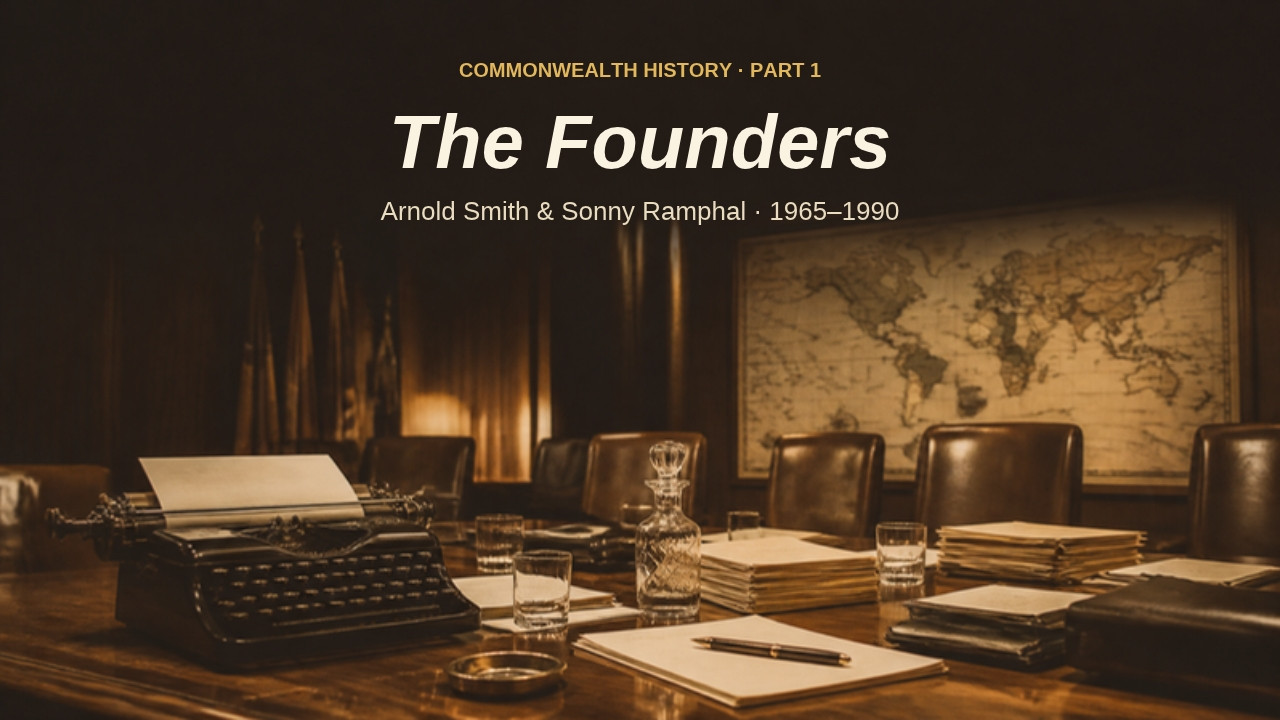
In short: Canada’s Arnold Smith (1965–1975) built the Commonwealth Secretariat from scratch and established its independence from Whitehall. Guyana’s Sir Shridath “Sonny” Ramphal (1975–1990) turned it into a moral and political force — leading the Commonwealth’s campaign against apartheid, supporting Zimbabwe’s path to independence and putting the vulnerability of small states on the global agenda.
The Commonwealth has had only seven Secretaries-General in more than six decades. The first two held the job for a quarter of a century between them, and much of what the Commonwealth is today — an association of equals with its own voice — was shaped in those years. This is the first of a CWN Times series on the people who have led the Commonwealth Secretariat.
Who was the first Commonwealth Secretary-General?
Arnold Smith, a Canadian career diplomat who had served in Moscow and Cairo, became the first Secretary-General when the Secretariat was created in 1965. He arrived to find no building of his own, a small staff and a British establishment that was not entirely comfortable with the idea of an independent Commonwealth official. For its first years, the Foreign Office did not even invite the Secretary-General to the Queen’s annual diplomatic reception — a slight the Queen herself corrected in 1968.
Smith’s quiet achievement was to establish that the Secretariat served all members, not London. That mattered enormously in his decade, as newly independent countries in Africa, Asia and the Caribbean joined and the Commonwealth’s centre of gravity moved south.
What did Arnold Smith achieve?
- Holding the club together over Rhodesia. Smith took office as white-minority Rhodesia declared unilateral independence in 1965. African members were furious with Britain’s response, and the crisis threatened to break the Commonwealth apart. Smith worked to keep the argument inside the family.
- The Singapore Declaration (1971). Leaders set out, for the first time, a shared statement of Commonwealth principles — including racial equality, opposition to colonial domination and support for representative government.
- Technical co-operation. In 1971 the Commonwealth Fund for Technical Co-operation was established, allowing members to share expertise with one another — a practical tool that still operates today.
Who was Sonny Ramphal?
Sir Shridath Surendranath Ramphal, known universally as “Sonny”, was a Guyanese lawyer and former foreign minister who served as Secretary-General from 1975 to 1990 — still the longest tenure of anyone in the post. He was the first Secretary-General from the developing world and the Caribbean, and he brought a sharp legal mind and a gift for public advocacy. He died in August 2024, aged 95, and was mourned across the Caribbean and the Commonwealth as one of its great statesmen.
How did the Commonwealth fight apartheid under Ramphal?
Ramphal made opposition to apartheid in South Africa the Commonwealth’s defining cause. Key moments included:
- The Gleneagles Agreement (1977), in which Commonwealth governments agreed to discourage sporting contact with apartheid South Africa — a powerful symbolic blow in sport-loving countries.
- The Lusaka meeting (1979), which helped lead to the Lancaster House talks and Zimbabwe’s independence in 1980.
- The Eminent Persons Group (1986), a high-level Commonwealth mission to South Africa whose findings strengthened the case for sanctions — often against the strong resistance of the British government of the day.
These were not cost-free positions. Ramphal’s Commonwealth repeatedly found itself at odds with London, and he was willing to let that tension show. Many historians credit the Commonwealth’s pressure as one of the international forces that helped bring apartheid to an end.
Why do small states owe so much to Ramphal?
Coming from a small Caribbean country, Ramphal understood that tiny island economies faced risks that large countries rarely considered: a single hurricane, a commodity price shock or an external debt crisis could wipe out years of progress. Under his leadership the Commonwealth produced influential work on the vulnerability of small states and argued for their special treatment in global economic policy. That advocacy remains one of the Commonwealth’s most distinctive contributions — today 33 of its 56 members are small states.
Ramphal was also a leading voice on the wider global stage, serving on the Brandt Commission on international development and later co-chairing the Commission on Global Governance.
How was the Secretariat created?
The decision to create a Commonwealth Secretariat was taken by prime ministers at their 1964 conference in London, and the new body was established the following year. Until then, Commonwealth meetings had been organised largely by the British government. The newly independent members of Africa, Asia and the Caribbean wanted an organisation that belonged to all of them equally — and the choice of a Canadian, rather than a Briton, as the first Secretary-General sent a clear signal about that intent.
Smith’s decade also saw the creation of practical programmes that still exist in some form today, including the Commonwealth Youth Programme, established in 1973 to support young people across member countries. After leaving office he set down his experience in a memoir, Stitches in Time: The Commonwealth in World Politics (1981), still a valuable account of how the modern Commonwealth took shape.
What other milestones came under Ramphal?
- The Lusaka Declaration on Racism and Racial Prejudice (1979), in which Commonwealth leaders committed to work for the eradication of racism.
- Global development thinking. His work on the Brandt Commission contributed to its influential 1980 report, North–South: A Programme for Survival, which argued for a fairer global economic system.
- Global governance. After leaving the Secretariat he co-chaired the Commission on Global Governance, whose 1995 report Our Global Neighbourhood set out ideas for reforming international institutions.
He remained an active public figure for decades, including in university leadership — he served as Chancellor of the University of Warwick in England and of the University of the West Indies — and as a respected adviser to Caribbean governments. When he died in 2024, tributes came from across the Commonwealth, with leaders describing him as one of the Caribbean’s greatest statesmen.
The bottom line
Smith gave the Commonwealth an institution; Ramphal gave it a conscience. Their 25 years set the template every later Secretary-General has had to live up to: independent of any one government, willing to take a stand on principle, and relentless in speaking up for the smallest members. For anyone assessing the Commonwealth’s relevance today, the founding era is a reminder of what the organisation can do when its members are united.
Frequently asked questions
Who was the first Commonwealth Secretary-General?
Arnold Smith of Canada was the first Commonwealth Secretary-General, serving from 1965 to 1975.
Who was the longest-serving Commonwealth Secretary-General?
Sir Shridath “Sonny” Ramphal of Guyana served the longest, from 1975 to 1990. Since 1993, Secretaries-General have been limited to two four-year terms.
What was the Gleneagles Agreement?
The 1977 Gleneagles Agreement was a Commonwealth commitment to discourage sporting contacts with apartheid South Africa.
Related on CWN Times: Anyaoku, McKinnon and Sharma · The Commonwealth’s greatest successes · Inside the Commonwealth Secretariat
Commonwealth
Cricket Diplomacy: How Sport Opens Doors for Commonwealth Business
From a cricket ground hosting the Commonwealth Business Forum to a cricket legend as summit envoy, sport sits at the heart of CHOGM 2026. Why sport remains one of the Commonwealth’s most powerful business connectors.
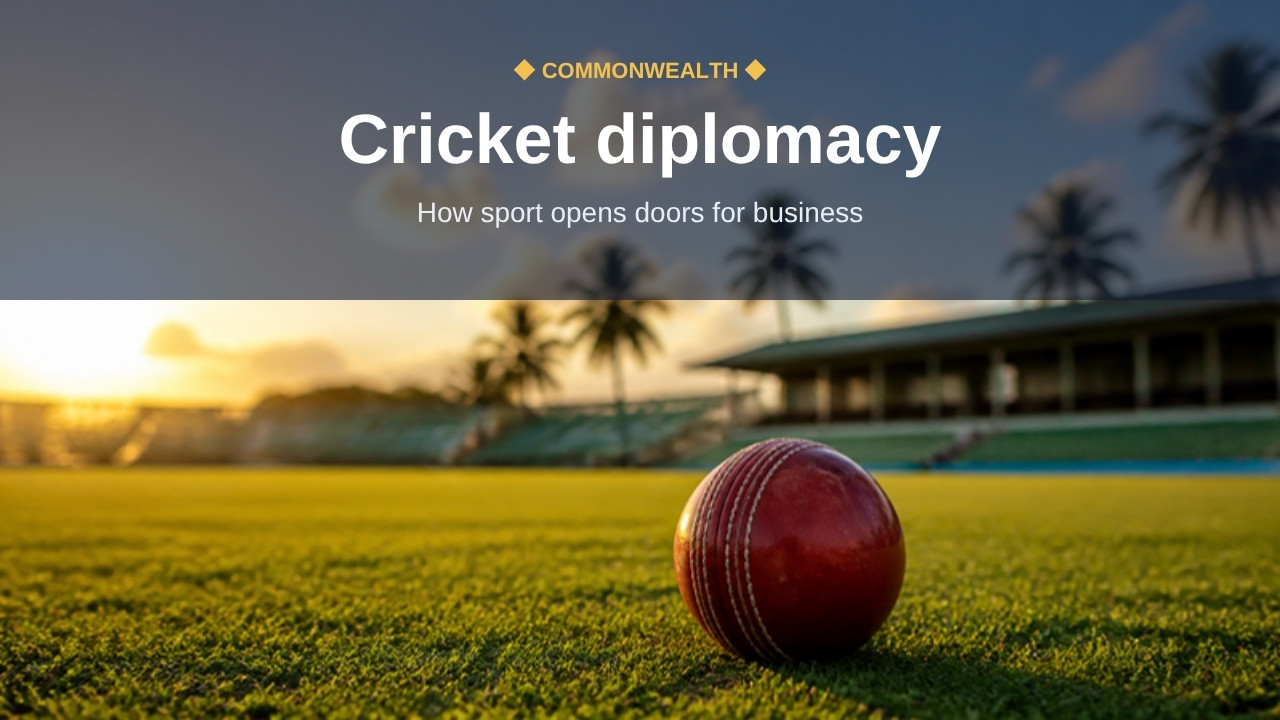
In short: At CHOGM 2026 in Antigua and Barbuda, cricket is more than a backdrop. Sir Vivian Richards is the summit’s envoy, the Commonwealth Business Forum is being held at the Sticky Wicket cricket ground, and a Commonwealth cricket celebration is part of the official programme. Sport builds the trust that trade depends on — and that makes it a serious business asset.
Ask anyone who has worked across the Commonwealth and they will tell you: conversations often start with cricket. A shared love of the game breaks the ice in boardrooms from London to Mumbai, Bridgetown to Johannesburg. It is no accident that the 2026 Commonwealth summit has put the sport front and centre.
How is cricket part of CHOGM 2026?
Antigua and Barbuda appointed cricket legend Sir Vivian Richards as CHOGM 2026 Envoy. “Cricket has always been much more than a game across the Commonwealth,” he said, describing how it would help bring the summit’s spirit to life by “creating opportunities to work together as one team”.
The Commonwealth Business Forum, which brings ministers and investors together from 2 to 4 November, is being held at the Sticky Wicket cricket ground, and Cricket West Indies is staging a Commonwealth cricket celebration as part of the summit programme. Weeks earlier, Ahmedabad hosted the first Commonwealth Kabaddi Championship — a sign that the Commonwealth’s sporting calendar is widening too.
Why does sport matter for business?
- Trust before transactions. Deals follow relationships, and few things build relationships faster than shared passion.
- Soft power. Sport shapes how countries see each other, opening doors for investment, tourism and education.
- A growing industry in its own right. Broadcasting, sponsorship, academies, venues, events and sports technology are serious commercial sectors across the Commonwealth.
- Community and inclusion. Grassroots and disability sport connect diaspora communities and give businesses meaningful ways to contribute.
How can businesses use sport as a bridge?
For UK firms looking at Commonwealth markets, sport offers practical routes in: hospitality at international fixtures, partnerships with academies and community programmes, sponsorship tied to trade events, and collaboration with sports bodies on facilities, technology and events. The key is authenticity — partnerships that genuinely support the game and its communities earn far more goodwill than logos on a hoarding.
Has sport shaped Commonwealth politics before?
Very much so. One of the Commonwealth’s most important political decisions was about sport. In the 1977 Gleneagles Agreement, Commonwealth governments agreed to discourage sporting contact with apartheid South Africa. In cricket- and rugby-loving countries, the isolation was felt keenly, and it became one of the most visible forms of international pressure on the apartheid system. When South Africa returned to the international game in the early 1990s, it marked one of the clearest signs that the country was changing.
Cricket also carries a unique form of regional unity in the Caribbean. The West Indies team draws players from a group of independent countries and territories that otherwise compete as separate nations — a rare example of sport creating a shared identity across borders.
How big is the business of cricket?
Cricket has become one of the most valuable sports properties in the world, largely thanks to the Twenty20 format and India’s enormous audience. The broadcast rights for the Indian Premier League for 2023 to 2027 were sold for around ₹48,390 crore — roughly US$6 billion — placing it among the most valuable sports leagues globally on a per-match basis. Franchise leagues now run in several Commonwealth countries, including the Caribbean, South Africa, Australia and the UK, with team owners, sponsors and broadcasters investing across borders.
The game’s global profile is set to grow further: cricket will return to the Olympic Games at Los Angeles 2028 for the first time since 1900. And the West Indies co-hosted the 2024 ICC Men’s T20 World Cup with the United States, showing how the Caribbean continues to use major events to attract visitors and investment.
What about the Commonwealth Games?
The Commonwealth Games remain the organisation’s best-known sporting event. They began as the British Empire Games in Hamilton, Canada, in 1930, and are notable for including para-sport events in the same programme as other events. Business forums are often held alongside the Games: the Commonwealth Enterprise and Investment Council ran a Commonwealth Games Business Forum during Birmingham 2022, linking the sporting spotlight to trade and investment. Glasgow was chosen to host the 2026 Games in a more compact format, returning to the city that staged them in 2014.
The bottom line
The Commonwealth’s shared language and legal systems make trade easier on paper. Sport makes it easier in person. Holding a business forum at a cricket ground is a reminder that, across these 56 countries, relationships are still built one conversation — and one match — at a time.
Frequently asked questions
Who is the CHOGM 2026 envoy?
Antigua and Barbuda appointed cricket legend Sir Vivian Richards as the CHOGM 2026 Envoy.
Where is the Commonwealth Business Forum 2026 held?
The 14th Commonwealth Business Forum takes place from 2 to 4 November 2026 at the Sticky Wicket cricket ground in Antigua and Barbuda.
What is sports diplomacy?
Sports diplomacy is the use of sport to build relationships and understanding between countries, which can support trade, investment, tourism and cultural ties.
Related on CWN Times: CHOGM 2026 opens in Antigua with investment at the top of the agenda · What is the Commonwealth?

Open Banking vs Card Payments: Which Is Better for Small Businesses?

The Founding Secretaries-General: How Arnold Smith and Sonny Ramphal Built the Modern Commonwealth

Cricket Diplomacy: How Sport Opens Doors for Commonwealth Business

Progress is Painfully Slow’: Rudolph Walker Discusses Equality for Black Actors in the Commonwealth

Vipul Jain to Be Honored at Rising Bharat Conclave 2024 in the House of Commons for Transforming Wealth Management in Tribal Communities

Commonwealth Nations Celebrate Unity and Progress Under ‘Together We Thrive’ Theme

-
 Community & Culture2 years ago
Progress is Painfully Slow’: Rudolph Walker Discusses Equality for Black Actors in the Commonwealth
-
 Community & Culture2 years ago
Vipul Jain to Be Honored at Rising Bharat Conclave 2024 in the House of Commons for Transforming Wealth Management in Tribal Communities
-
 News2 years ago
Commonwealth Nations Celebrate Unity and Progress Under ‘Together We Thrive’ Theme
-

 Community & Culture2 years ago
Sri Lanka to Host Malayalam Film Starring Mammootty and Mohanlal: A Cultural Collaboration in the Commonwealth
-

 News2 years ago
Harnessing AI for Sustainable Tourism Growth in Zimbabwe: A Commonwealth Initiative
-

 Education2 years ago
Dominican Chairman Oversees Caribbean Plant Health Directors Annual Meeting, Strengthening Commonwealth Agricultural Collaboration
-

 News2 years ago
BIMSTEC Summit 2025 Highlights Regional Cooperation Aligned with Commonwealth Development Goals
-

 News2 years ago
INS Talwar Docks in Mombasa, Strengthening Kenya-India Naval Collaboration as Part of Commonwealth Relations