
Explainers
What Is an Electronic Money Institution? EMI vs Bank, Explained
Many business accounts and payment apps in the UK are provided by electronic money institutions, not banks. Here is what an EMI is, how your money is protected, and what to check before you choose one.


In short: An electronic money institution (EMI) is a firm authorised by the Financial Conduct Authority to issue e-money and provide payment services such as accounts, cards and transfers. Unlike a bank, an EMI cannot lend out customer money. Instead, it must safeguard it — keeping it separate from its own funds. E-money is generally not covered by the FSCS, so how a provider safeguards funds really matters.
Open a business account with a modern fintech, pay with a digital wallet or receive funds through an online payments platform, and there is a good chance the provider is an EMI rather than a bank. EMIs have transformed how small businesses move money — often faster and cheaper than traditional banking. But the way they hold your money is different, and every business owner should understand it.
What is an electronic money institution?
In the UK, EMIs are authorised and supervised by the Financial Conduct Authority (FCA) under the Electronic Money Regulations 2011. They can issue electronic money — a digital store of value in exchange for funds received — and offer payment services such as accounts with sort codes and IBANs, payment cards, domestic and international transfers, and merchant payment acceptance.
What is the difference between an EMI and a bank?
| Bank | Electronic money institution | |
|---|---|---|
| Can lend customer deposits | Yes | No |
| Pays interest on balances | Often | Not on e-money itself |
| FSCS protection (up to the limit) | Yes, for eligible deposits | Generally no |
| How customer money is protected | Capital rules and FSCS | Safeguarding, kept separate from the firm’s own money |
| Regulator | PRA and FCA | FCA |
How is money held with an EMI protected?
EMIs must safeguard customer funds, typically by holding them in a segregated account at a bank or by covering them with an insurance policy or guarantee. If the EMI fails, safeguarded funds are meant to be returned to customers ahead of the firm’s other creditors.
In practice, past failures exposed weaknesses: the FCA found that payment firms which became insolvent between 2018 and 2023 had average shortfalls of 65% of customer funds. In response, new FCA safeguarding rules — known as CASS 15 — took effect on 7 May 2026. They require daily checks that the right amount is safeguarded, monthly reporting, annual audits for firms holding more than £100,000 of customer funds, and better plans to return money quickly if a firm fails.
What should a business check before choosing an EMI?
- Check the FCA Register. Confirm the firm is authorised as an EMI (or is an agent of one) and note its firm reference number.
- Ask how funds are safeguarded — with which bank, and whether by segregation or insurance.
- Understand fees and FX. Compare transaction, currency conversion and settlement costs, not just the headline price.
- Check settlement times and limits, especially if cash flow depends on fast access to card takings.
- Don’t keep all your eggs in one basket. Many businesses use an EMI for payments alongside a bank account for reserves.
The bottom line
EMIs have brought speed, choice and lower costs to business payments, and the new safeguarding rules make the sector stronger. The key for business owners is simple: know who holds your money, how it is protected, and use the right provider for the right job.
Frequently asked questions
Is money in an EMI account protected by the FSCS?
Generally no. E-money is not covered by the Financial Services Compensation Scheme. Instead, EMIs must safeguard customer funds by keeping them separate from their own money.
Who regulates electronic money institutions in the UK?
The Financial Conduct Authority authorises and supervises EMIs under the Electronic Money Regulations 2011. You can check any firm on the FCA Register.
What are the new FCA safeguarding rules?
New rules, known as CASS 15, took effect on 7 May 2026. They require payment and e-money firms to check safeguarded funds daily, report monthly, have annual audits (above £100,000 of customer funds) and plan for returning money quickly if they fail.


Commonwealth
Inside the Commonwealth Secretariat: How the 56-Nation Club Is Run from London
From a historic house on Pall Mall, a small international organisation serves 56 countries and 2.7 billion people. Who runs the Commonwealth Secretariat, who pays for it, and what does it actually do?
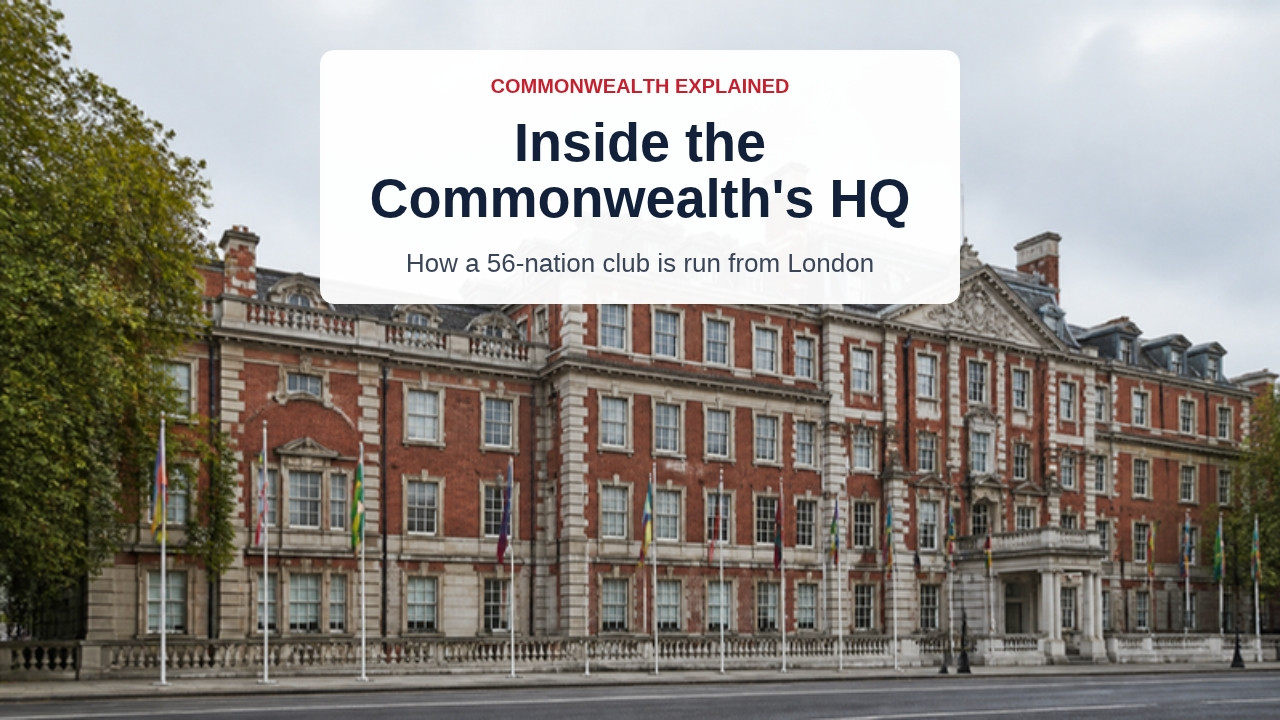
In short: The Commonwealth Secretariat is the intergovernmental body that turns the decisions of 56 member countries into practical work. Founded in 1965 and based at Marlborough House on Pall Mall, London, it is led by a Secretary-General, overseen by a Board of Governors made up of member countries’ High Commissioners, and funded mainly by member governments. Its priorities are set by leaders at the Commonwealth Heads of Government Meeting (CHOGM) every two years.
Most people know the Commonwealth through the Commonwealth Games, the King’s Commonwealth Day message or the summit photographs of leaders lined up in the sunshine. Far fewer know about the organisation that keeps the whole enterprise running between those moments. The Commonwealth Secretariat is small by the standards of international bodies, yet it serves a family of 56 countries that is home to around 2.7 billion people — roughly a third of humanity.
What is the Commonwealth Secretariat?
The Secretariat is the Commonwealth’s main intergovernmental agency. It was created by Commonwealth prime ministers in 1965, at a time when decolonisation was rapidly adding new independent members and the old model — in which Britain’s Commonwealth Relations Office effectively hosted the club — no longer worked. Leaders wanted an organisation that belonged to all members equally, with its own staff and its own head.
That principle still matters. The Secretariat is not an arm of the British government, even though it sits a short walk from Downing Street. It answers to all 56 members, and its Secretary-General is chosen by heads of government collectively.
Why is it based at Marlborough House?
Marlborough House, built in the early 1700s to a design by Sir Christopher Wren for Sarah, Duchess of Marlborough, was a royal residence for much of its history. Queen Elizabeth II placed it at the disposal of the British government for use as a Commonwealth centre, and it has housed the Secretariat since 1965. It is also home to the Commonwealth Foundation, the sister organisation that works with civil society.
The building gives the Commonwealth a distinctive diplomatic stage in London — a neutral meeting place where ministers, High Commissioners and officials from Africa, Asia, the Caribbean, the Pacific, Europe and the Americas can meet as equals.
Who runs the Secretariat?
Day to day, the Secretariat is led by the Secretary-General, currently Shirley Botchwey of Ghana, who took office on 1 April 2025. The Secretary-General is supported by deputy secretaries-general and a professional staff drawn from across member countries.
Oversight comes from three levels:
- Heads of government set the overall direction at CHOGM, held every two years, and elect the Secretary-General for terms of four years, with a maximum of two terms.
- The Board of Governors, made up of member countries’ High Commissioners in London, usually meets once a year to approve the Secretariat’s strategic plan, work programme and budget.
- The Executive Committee of the Board meets more frequently to scrutinise performance, finances and delivery between Board meetings.
In September 2025 the Board approved the Secretariat’s Strategic Plan 2025–2030, built on three pillars: democratic resilience, economic resilience and environmental resilience, with young people, women and small states as cross-cutting priorities.
Who pays for the Commonwealth Secretariat?
Member governments do. Each country pays an assessed contribution to the core budget, calculated broadly according to its capacity to pay, so larger and wealthier economies such as the UK, Canada and Australia carry the biggest shares while small island states pay modest amounts. On top of this, governments can make voluntary contributions to specific funds, most notably the Commonwealth Fund for Technical Co-operation (CFTC), set up in 1971 to share expertise between members.
This funding model means every member has a stake in the Secretariat’s success, from the largest economies to the smallest island states.
What does the Secretariat actually do?
Its work falls into a few broad areas:
- Democracy and governance — observing elections, supporting parliaments, strengthening the rule of law and human rights institutions.
- Trade and economic development — advising governments on trade negotiations, investment and the “Commonwealth advantage” of shared language and legal systems.
- Debt and public finance — through its Commonwealth Meridian software and advisory teams, it helps finance ministries record and manage public debt.
- Climate and oceans — through the Commonwealth Climate Finance Access Hub, which places advisers inside governments to help them secure climate finance, and the Commonwealth Blue Charter on ocean protection.
- Small states advocacy — 33 of the 56 members are small states, and the Secretariat champions their interests in global forums.
- Convening — organising CHOGM and regular meetings of finance, law, health, education, trade, foreign and other ministers.
How is it different from other Commonwealth organisations?
The Commonwealth is a wider family than the Secretariat alone. The Commonwealth Foundation supports civil society; the Commonwealth of Learning, based in Canada, promotes open and distance education; and dozens of accredited professional and civil society bodies — from lawyers and journalists to local government and universities — carry the Commonwealth name. The Commonwealth Games Federation, which runs the Games, is separate again. The Secretariat is the one that works directly for governments.
Which countries does the Secretariat serve?
The Secretariat works for all 56 members, spread across every inhabited continent:
| Region | Members |
|---|---|
| Africa | 21 |
| Asia | 8 |
| Caribbean and Americas | 13 |
| Europe | 3 |
| Pacific | 11 |
Members range from India, with well over a billion people, to Nauru and Tuvalu, with populations of around 10,000. That spread is one of the Secretariat’s biggest challenges: it has to be useful to some of the world’s largest economies and to some of its smallest states at the same time.
Does the Secretariat work outside London?
Yes. Small countries often cannot afford full diplomatic missions in the world’s main negotiating centres, so the Commonwealth runs Small States Offices in Geneva and New York. They give member countries without a permanent presence subsidised office space and support, helping them take part in negotiations at the United Nations, the World Trade Organization and other bodies. Secretariat staff and advisers also work directly in member countries on specific programmes, such as the climate finance advisers placed inside governments.
How can businesses and organisations engage with it?
The Secretariat works mainly with governments, but there are several ways for others to connect with its work. Professional associations, universities and civil society bodies can apply for accreditation, which gives them a recognised relationship with the Commonwealth. Businesses usually engage through the Commonwealth Enterprise and Investment Council, which runs the Commonwealth Business Forum alongside each CHOGM, and through programmes such as the Commonwealth Investment Platform, launched in October 2026 to showcase investment-ready projects from member countries.
The Secretariat also publishes a large body of research and policy work through its online library, covering trade, debt, oceans, law and governance. For anyone researching a Commonwealth market, it is a useful and often overlooked resource.
When is the Commonwealth most visible?
Beyond CHOGM, the most visible moment in the Commonwealth calendar is Commonwealth Day, held on the second Monday of March each year, with a service at Westminster Abbey and celebrations across member countries. The Secretariat co-ordinates the theme each year; in 2026 it was “Unlocking opportunities for a prosperous Commonwealth”.
The bottom line
The Commonwealth Secretariat is a lean organisation with an outsized network. Its influence rarely comes from money or power; it comes from convening — getting finance ministers, trade officials and leaders from very different countries into the same room, in a shared language, under shared rules. For businesses and policymakers in the UK, understanding how Marlborough House works is the first step to using the Commonwealth network well.
Frequently asked questions
Where is the Commonwealth Secretariat based?
The Commonwealth Secretariat is headquartered at Marlborough House on Pall Mall in London, where it has been based since it was founded in 1965.
Is the Commonwealth Secretariat part of the UK government?
No. It is an intergovernmental organisation that serves all 56 member countries equally. Its Secretary-General is elected by Commonwealth heads of government.
How is the Commonwealth Secretariat funded?
Mainly through assessed contributions from member governments, scaled to their capacity to pay, plus voluntary contributions to funds such as the Commonwealth Fund for Technical Co-operation.
Related on CWN Times: How the Secretariat works with governments · The founding Secretaries-General · CHOGM 2026 opens in Antigua
Explainers
Card Processing Fees in the UK: A Plain-English Guide for Small Businesses
Every card payment carries a fee — but few business owners know what they are actually paying for. Here is how UK card processing fees work, what is capped, and how to keep costs under control.

In short: A UK card fee is made up of three parts — interchange (paid to the cardholder’s bank), scheme fees (paid to Visa or Mastercard) and the acquirer’s margin (paid to your payment provider). Interchange on UK consumer cards is capped at 0.2% for debit and 0.3% for credit, but business cards and many international cards are not capped — which is where costs often creep up.
For most small businesses, card payments are no longer optional. Customers expect to tap, click or pay by phone. But the monthly statement from a payment provider can be hard to read, and many owners only discover what they are paying when margins start to feel tight. Understanding the structure is the first step to paying less.
What makes up a card processing fee?
- Interchange: the largest part, paid to the bank that issued the customer’s card. For UK consumer cards it is capped by regulation at 0.2% of the transaction for debit and 0.3% for credit.
- Scheme fees: charged by the card networks for using their rails. They vary by card type, transaction type and region.
- Acquirer margin: what your payment provider charges for processing, settlement, risk and support. This is the part you can negotiate.
Which card payments cost more?
The caps only apply to UK consumer cards. Commercial and corporate cards are not capped, and interchange on some cross-border payments can be considerably higher. Online, or “card-not-present”, payments also tend to cost more than in-person transactions because the fraud risk is higher. A business with many corporate customers or international buyers can therefore pay far more than the headline rate suggests.
Blended pricing or Interchange++?
Providers usually price in one of two ways. Blended (flat-rate) pricing charges one simple percentage on everything — easy to understand, but you may overpay on cheap debit transactions. Interchange++ passes through the actual interchange and scheme fees and adds a clear margin on top — more complex to read, but usually fairer for businesses with steady volumes.
How can a small business reduce card fees?
- Know your card mix. Ask your provider for a breakdown of debit, credit, commercial and international transactions. Your mix decides which pricing model suits you.
- Check the “hidden” lines. Monthly minimums, terminal rental, PCI compliance charges, refund fees and chargeback fees all add up.
- Benchmark once a year. As volumes grow, your negotiating position improves. A short review can unlock better rates.
- Reduce chargebacks. Clear descriptors on statements, good receipts and strong fraud tools cut disputes and their fees.
- Consider alternatives such as open banking “pay by bank” for larger or recurring payments.
What does the interchange cap mean in pounds and pence?
Percentages can feel abstract, so it helps to put numbers on them. On a £20 purchase made with a UK consumer debit card, the regulated cap means interchange can be no more than 4p (0.2%). On a £20 consumer credit card purchase, the cap is 6p (0.3%). Scheme fees and the provider’s margin then sit on top of that.
The same £20 paid with an uncapped corporate card or a card issued outside the UK can carry interchange that is several times higher. That is why two businesses with identical turnover can end up with very different card bills: the difference is usually in who their customers are and how they pay, not in the headline rate.
Can a business charge customers extra for paying by card?
Not for most everyday purchases. Since January 2018, UK businesses have been banned from adding a surcharge when consumers pay with personal debit or credit cards, and with many other common payment methods. The ban does not cover payments made with commercial or corporate cards, but any surcharge there must not exceed the actual cost to the business of accepting that card.
In practice, this means card costs have to be built into pricing rather than passed on at the till. That makes understanding and managing those costs even more important.
What should you look for in a payment provider contract?
The rate is only part of the deal. Before signing, it is worth checking:
- Contract length and exit terms — some terminal agreements run for several years and carry early termination fees.
- Terminal costs — whether card machines are bought outright, rented monthly or included.
- Settlement speed — how quickly money reaches your bank account, which matters for cash flow.
- PCI DSS requirements — the Payment Card Industry Data Security Standard sets security rules for anyone handling card data. Ask what your provider expects you to do and whether it charges a compliance fee.
- Support — what happens when a terminal fails on a busy Saturday.
Are card fees under regulatory scrutiny?
Yes. While interchange on UK consumer cards is capped, the other parts of the fee are not. The Payment Systems Regulator has examined card scheme and processing fees, and the interchange charged on online payments between the UK and the European Economic Area rose significantly after Brexit, when the old EU caps stopped applying to those transactions. Businesses selling online to European customers should keep an eye on how these rules develop, as they can have a direct effect on costs.
The bottom line
Card fees are not fixed costs — they are a commercial agreement. Businesses that understand their card mix and read their statements line by line are almost always in a position to pay less, and to choose a provider that genuinely fits how they trade.
Frequently asked questions
What is the interchange cap in the UK?
Interchange on UK consumer cards is capped at 0.2% of the transaction value for debit cards and 0.3% for credit cards. Commercial cards are not capped.
What is Interchange++ pricing?
Interchange++ passes the actual interchange and card scheme fees through to the merchant and adds a fixed, transparent margin from the payment provider.
Why are online card payments more expensive?
Card-not-present payments carry higher fraud risk, so interchange and processing costs are typically higher than for in-person contactless or chip-and-PIN payments.
Related on CWN Times: What is an electronic money institution? EMI vs bank, explained
Explainers
UK–India Trade Deal Explained: What It Means for UK Small Businesses
The UK–India Comprehensive Economic and Trade Agreement has been in force since 15 July 2026. Here is what it changes, which UK sectors benefit and how small businesses can actually claim the lower tariffs.
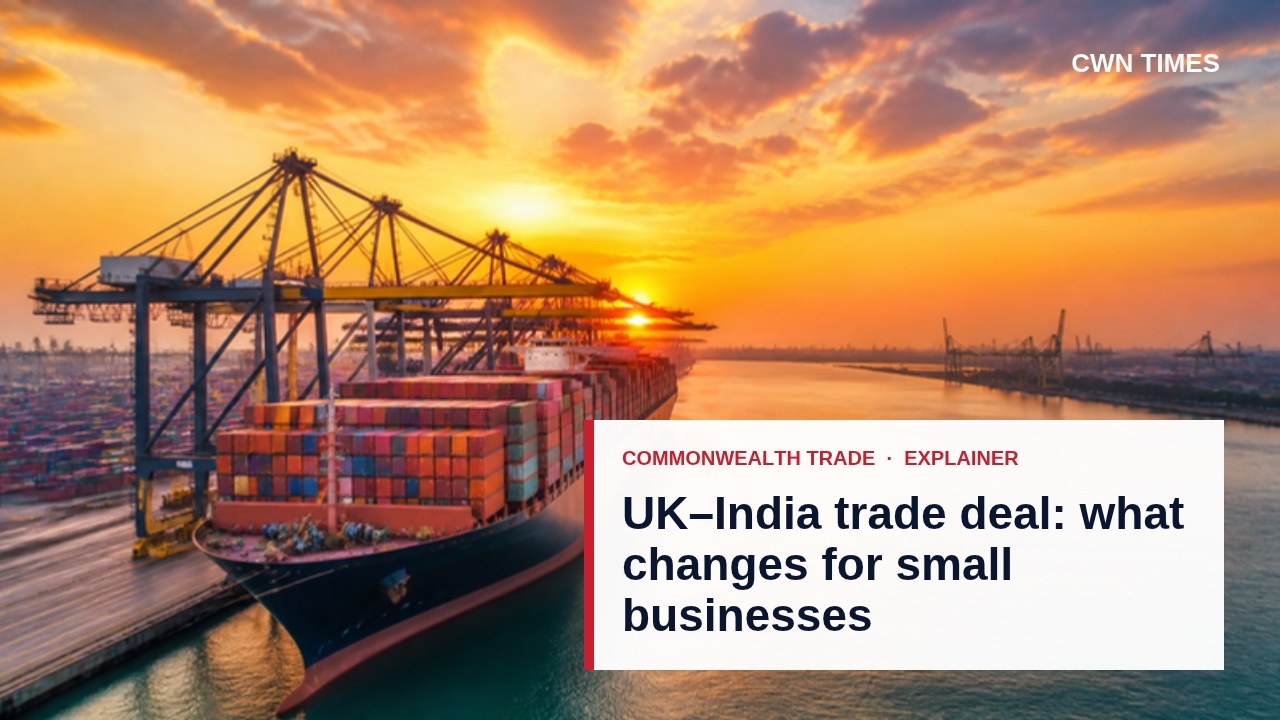
In short: The UK–India Comprehensive Economic and Trade Agreement (CETA) came into force on 15 July 2026. India is cutting or removing tariffs on around 90% of UK goods, and the UK government forecasts bilateral trade will rise by £25.5 billion a year in the long run. But lower tariffs are not automatic — businesses must meet the rules of origin and register with HMRC to claim them.
India is the world’s most populous country and one of its fastest-growing major economies. For years, high import tariffs made it a difficult market for many British firms. The new trade agreement — signed in July 2025 and in force since July 2026 — is designed to change that. According to the UK government, UK–India trade was worth £48 billion in 2025.
What does the UK–India trade deal actually change?
The headline change is on tariffs. The UK government says 90% of UK goods exported to India now enter duty-free or at reduced rates, while 99% of Indian goods entering the UK benefit. Many of India’s cuts are phased in over several years rather than all at once.
Some examples from official UK guidance:
- Scotch whisky: cut from 150% to 75% on day one, falling to 40% over ten years
- Fresh or chilled Atlantic salmon: 33% tariff removed immediately
- Car gearboxes: 16.5% tariff falling in equal annual steps to zero by 2035
- Other sectors: reductions across food and drink, textiles, chemicals, pharmaceuticals, machinery, cosmetics and medical technology
The government estimates the deal will cut tariffs on UK exports by up to £400 million a year at the start, rising to £900 million after ten years, and add £4.8 billion a year to UK GDP in the long run.
Which UK businesses benefit most?
Early winners include food and drink producers, premium consumer brands, automotive and engineering suppliers, medical technology and the creative industries. Retail brands are already moving: several British consumer businesses have announced expansion plans in India since the deal took effect.
Services provisions are more limited than goods, according to the House of Commons Library — so professional and digital service firms should look closely at the detail for their sector rather than assume a major change.
How does a small business claim the lower tariffs?
- Check your product’s tariff. Find its commodity code and the new rate using the UK government’s “Check how to export goods” service.
- Confirm rules of origin. Goods must be wholly produced in the UK, or meet the product-specific rules if they include imported materials.
- Register with HMRC. UK exporters must be registered before making origin declarations — unregistered declarations are rejected.
- Issue a self-certified origin declaration to your Indian importer so they can claim the preferential rate.
- Use the support available. India offers advance rulings on classification, origin and valuation, and Department for Business and Trade advisers can help first-time exporters.
What should businesses watch out for?
Implementation is still bedding in. The first public dispute — over whether bulk Scotch imports qualify for the lower whisky tariff — shows that interpretation can differ in practice. Businesses should keep good records, get advance rulings where possible and work with experienced partners on the ground. Payments, currency and cash-flow planning also matter: longer shipping and payment cycles can strain smaller firms entering India for the first time.
The bottom line
The trade deal opens a door; it does not walk businesses through it. The firms that gain most will be those that do the paperwork properly, understand Indian buyers and build trusted local partnerships. For many UK SMEs, this is the best moment in a generation to take India seriously.
Frequently asked questions
When did the UK–India trade deal come into force?
The UK–India Comprehensive Economic and Trade Agreement was signed on 24 July 2025 and came into force on 15 July 2026.
How much will the UK–India trade deal boost trade?
The UK government forecasts bilateral trade will increase by £25.5 billion a year in the long run, with UK GDP rising by £4.8 billion a year.
Do UK exporters need to register to use the deal?
Yes. UK exporters must be registered with HMRC before making origin declarations, and goods must meet the agreement’s rules of origin to qualify for lower tariffs.
Related on CWN Times: India–UK sign historic CETA · CHOGM 2026 opens in Antigua

Cricket Diplomacy: How Sport Opens Doors for Commonwealth Business

Inside the Commonwealth Secretariat: How the 56-Nation Club Is Run from London

Card Processing Fees in the UK: A Plain-English Guide for Small Businesses

Progress is Painfully Slow’: Rudolph Walker Discusses Equality for Black Actors in the Commonwealth

Vipul Jain to Be Honored at Rising Bharat Conclave 2024 in the House of Commons for Transforming Wealth Management in Tribal Communities

Commonwealth Nations Celebrate Unity and Progress Under ‘Together We Thrive’ Theme

-
 Community & Culture2 years ago
Progress is Painfully Slow’: Rudolph Walker Discusses Equality for Black Actors in the Commonwealth
-
 Community & Culture2 years ago
Vipul Jain to Be Honored at Rising Bharat Conclave 2024 in the House of Commons for Transforming Wealth Management in Tribal Communities
-
 News2 years ago
Commonwealth Nations Celebrate Unity and Progress Under ‘Together We Thrive’ Theme
-

 Community & Culture2 years ago
Sri Lanka to Host Malayalam Film Starring Mammootty and Mohanlal: A Cultural Collaboration in the Commonwealth
-

 News2 years ago
Harnessing AI for Sustainable Tourism Growth in Zimbabwe: A Commonwealth Initiative
-

 Education2 years ago
Dominican Chairman Oversees Caribbean Plant Health Directors Annual Meeting, Strengthening Commonwealth Agricultural Collaboration
-

 News2 years ago
BIMSTEC Summit 2025 Highlights Regional Cooperation Aligned with Commonwealth Development Goals
-

 News2 years ago
INS Talwar Docks in Mombasa, Strengthening Kenya-India Naval Collaboration as Part of Commonwealth Relations