
Commonwealth
The Diaspora Effect: How Communities Power UK–Commonwealth Trade
Millions of Britons have roots across the Commonwealth. Their networks, knowledge and trust are among the UK’s most underused trade assets.

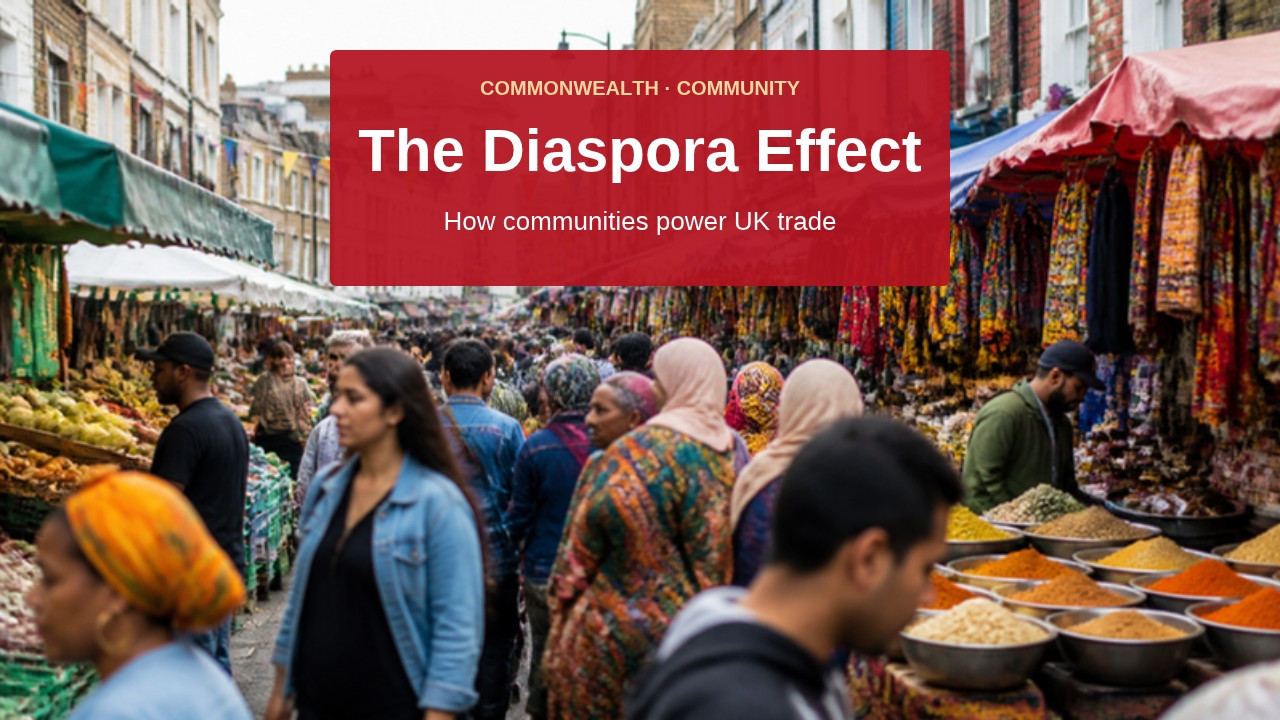
In short: Diaspora communities give the UK something trade deals cannot: people who understand both markets, speak the languages and are trusted on both sides. The 2021 Census recorded around 1.86 million people of Indian heritage in England and Wales, alongside large Bangladeshi, African, Caribbean and other Commonwealth communities. Their networks quietly lower the cost of doing business across the Commonwealth.
Trade is usually discussed in terms of tariffs, quotas and treaties. But anyone who has helped a business enter a new market knows the decisive factor is often simpler: who do you know, and do they trust you? That is where diaspora communities make the difference.
How big are the UK’s Commonwealth diaspora communities?
According to the 2021 Census for England and Wales, people of Indian heritage numbered around 1.86 million (3.1% of the population), Bangladeshi around 645,000, Black African around 1.49 million and Black Caribbean around 623,000. Many more have roots in Sri Lanka, Nigeria, Ghana, Kenya, Malaysia, Singapore and beyond.
How did these communities come to Britain?
The story of Britain’s Commonwealth communities is, in large part, the story of post-war Britain. When the HMT Empire Windrush docked at Tilbury on 22 June 1948, carrying passengers from the Caribbean who had come to help rebuild the country, it marked the start of a generation of migration that reshaped British life. That date is now marked each year as Windrush Day.
Migration from India and other parts of South Asia grew through the 1950s and 1960s, often to fill labour shortages in textiles, manufacturing and transport. In the late 1960s and early 1970s, many people of Indian heritage arrived from East Africa — most famously in 1972, when tens of thousands of Ugandan Asians expelled by Idi Amin resettled in Britain. Many arrived with little but went on to build businesses in retail, pharmacy, wholesale, manufacturing and professional services, becoming one of the UK’s most entrepreneurial communities.
Migration from West Africa — particularly Nigeria and Ghana — and from other Commonwealth countries has grown steadily since, bringing new generations of professionals, students and entrepreneurs.
How do diaspora communities drive trade?
- Market knowledge: understanding of customers, culture, regulation and how business really gets done.
- Trust networks: family, community and alumni links that shorten the path to a first meeting and a first deal.
- Entrepreneurship: diaspora-led businesses that import, export and invest in both directions.
- Consumer demand: communities that create UK markets for products from home — and introduce them to the wider public.
- Capital flows: remittances and investment that support businesses and families across the Commonwealth.
How large are diaspora money flows?
Remittances — money sent home by people working abroad — are one of the most tangible economic links between the UK and Commonwealth countries. India has for years been the world’s largest recipient of remittances, receiving well over US$100 billion a year according to World Bank estimates, a share of it from the UK. For several smaller Commonwealth economies, remittances are equivalent to a significant proportion of national income.
These flows matter for business too. They fund homes, education and small enterprises, and they have driven innovation in cross-border payments, as fintech firms compete to make sending money faster and cheaper. Increasingly, diaspora capital also flows as investment rather than family support — into property, start-ups and listed companies in the countries of heritage.
Why are diaspora networks underused?
Too often, diaspora communities are seen through a cultural lens alone, rather than as economic partners. Business councils, chambers and community organisations do valuable work connecting firms with markets, but they are rarely built into mainstream trade strategy. Mainstream UK businesses, meanwhile, frequently overlook the expertise sitting inside their own workforce and supplier base.
How can businesses tap diaspora networks?
- Join business councils and chambers focused on specific Commonwealth markets.
- Ask your own team. Colleagues with roots in a target market often have insight no consultant can match.
- Attend community and cultural events — festivals and celebrations are where relationships begin.
- Partner with diaspora-led firms that already trade in both directions.
The bottom line
Trade agreements lower the barriers; people carry the business across. The UK’s Commonwealth diaspora is a living bridge to some of the world’s fastest-growing markets — and the businesses that recognise that will move faster than those that rely on paperwork alone.
Frequently asked questions
How many people of Indian heritage live in the UK?
The 2021 Census recorded around 1.86 million people of Indian ethnicity in England and Wales, about 3.1% of the population.
What is the diaspora effect in trade?
It describes how migrant and heritage communities increase trade between countries by sharing market knowledge, building trust and creating demand in both directions.
How can a UK business use diaspora networks?
Join market-focused business councils and chambers, draw on colleagues’ knowledge, attend community events and partner with diaspora-led firms already trading in your target market.
Related on CWN Times: Diwali 2026 and UK businesses · What is the Commonwealth?


Commonwealth
How the Commonwealth Secretariat Works With Governments: From CHOGM to Debt Software
The Commonwealth has no army and no binding laws. So how does its Secretariat influence governments? Through summits, ministerial meetings, technical experts, election observers and a quiet pressure group called CMAG.

In short: The Commonwealth works by consensus, not compulsion. Its Secretariat influences governments in five main ways: setting priorities with leaders at CHOGM; convening regular meetings of ministers; providing technical experts and tools such as the Commonwealth Meridian debt system; observing elections; and, when members break with Commonwealth values, acting through the Commonwealth Ministerial Action Group (CMAG), which can recommend suspension.
Unlike the European Union, the Commonwealth makes no laws. Unlike the United Nations Security Council, it cannot impose sanctions that bind everyone. Its 56 members join voluntarily and can leave at will. That makes the question of how the Commonwealth Secretariat actually gets things done more interesting — and the answer says a lot about how soft power works.
How are Commonwealth decisions made?
The top decision-making forum is the Commonwealth Heads of Government Meeting (CHOGM), held every two years in a different member country. Leaders agree priorities, adopt declarations and communiqués, and every second summit elect or re-elect the Secretary-General. Decisions are taken by consensus, which means any outcome needs broad agreement — slow, sometimes frustrating, but it gives agreed positions real legitimacy.
A defining feature of CHOGM is the leaders’ retreat: a private session where heads of government talk without officials or scripts. Many of the Commonwealth’s most important breakthroughs have come out of these informal conversations.
What happens between summits?
Most of the day-to-day work happens through ministerial meetings organised by the Secretariat. Commonwealth finance ministers traditionally meet ahead of the IMF and World Bank annual meetings; health ministers meet before the World Health Assembly; and there are regular meetings for law, education, trade, foreign affairs, youth and women’s affairs ministers. These gatherings let ministers compare notes, agree joint positions for global negotiations and commission practical work from the Secretariat.
In London, member countries’ High Commissioners form the Board of Governors, which approves the Secretariat’s plans and budget, and stay in constant contact with Marlborough House.
What practical help does the Secretariat give governments?
- Public debt management. The Secretariat’s debt recording system, first CS-DRMS and now Commonwealth Meridian, is used by finance ministries and central banks in dozens of countries to record and analyse public debt.
- Legal and constitutional advice. Specialist lawyers help members draft legislation, reform justice systems and tackle issues such as cybercrime and anti-money laundering.
- Trade expertise. Advisers help smaller members prepare for trade negotiations and make use of preferential trade deals.
- Climate finance. The Commonwealth Climate Finance Access Hub embeds advisers inside governments to prepare funding proposals — unlocking almost US$600 million in climate finance by 2026, according to the Secretariat.
- Natural resources and oceans. Advisers support maritime boundary work and sustainable management of fisheries and minerals.
Much of this is funded through the Commonwealth Fund for Technical Co-operation, established in 1971, which lets members draw on expertise from across the family — often from other developing countries that have faced similar challenges.
What are Commonwealth model laws?
Because most members share common law traditions, the Commonwealth can do something few international organisations can: draft model legislation that countries adapt and pass into their own law. An early example was the 2002 Commonwealth Model Law on Computer and Computer-Related Crime, which helped several member states introduce cybercrime laws at a time when many had none. Model laws and guidance have since covered areas such as evidence in electronic form, anti-money laundering and the rights of victims. For smaller countries with limited legal drafting capacity, these templates save years of work — and they make laws more compatible across borders, which helps investors and traders.
How does the Commonwealth turn agreements into action?
Many of the Secretariat’s programmes began as commitments made by leaders at CHOGM. The Commonwealth Climate Finance Access Hub was agreed at the 2015 summit in Malta; the Commonwealth Blue Charter and the Connectivity Agenda on trade and investment were adopted at the 2018 summit in London; and the Living Lands Charter on land and biodiversity came out of the 2022 summit in Kigali. Each is then delivered through the Secretariat, working with groups of member countries that volunteer to lead on specific issues — an approach that allows action without requiring all 56 members to move at the same pace.
How does the Commonwealth observe elections?
When a member government invites it, the Secretary-General can send a Commonwealth Observer Group, usually led by a former head of state or government, to assess an election. Observers publish their findings and recommendations, which often feed into electoral reform. Secretary-General Shirley Botchwey has called for more agile missions and invited Commonwealth parliamentarians to take part.
What is CMAG and what can it do?
The Commonwealth Ministerial Action Group (CMAG) was created in 1995 under the Millbrook Programme, which put teeth into the 1991 Harare Declaration on democracy and good governance. A rotating group of foreign ministers, CMAG deals with “serious or persistent violations” of Commonwealth values — such as military coups. It can engage with the government concerned, send envoys and recommend partial or full suspension from Commonwealth councils.
CMAG has acted on several occasions — over Nigeria in the 1990s, Fiji after its coups, and most recently Gabon, which was partially suspended after a 2023 coup and restored to full membership in July 2025 after elections.
The bottom line
The Commonwealth’s power is the power of the network: peer pressure, shared expertise and a seat at a table where small countries are heard as equals. Its quietest tools — debt software, legal drafting, climate finance advisers — often do more practical good than its headline summits. Anyone dealing with Commonwealth governments benefits from understanding that this is a system built on relationships, not rules.
Frequently asked questions
How often does CHOGM take place?
CHOGM is normally held every two years, hosted by a different member country. CHOGM 2026 is being held in Antigua and Barbuda from 1 to 4 November.
Can the Commonwealth suspend a member?
Yes. The Commonwealth Ministerial Action Group can recommend partial or full suspension of a member that seriously violates Commonwealth values, for example after a military coup.
What is Commonwealth Meridian?
Commonwealth Meridian is the Commonwealth Secretariat’s software for recording, managing and analysing public debt, used by finance ministries and central banks.
Related on CWN Times: Inside the Commonwealth Secretariat · Suspensions, exits and returns · Shirley Botchwey’s agenda
Commonwealth
Shirley Botchwey: The Commonwealth’s First African Woman Secretary-General and Her Agenda
Ghana’s former foreign minister took charge of the Commonwealth Secretariat in April 2025. Here is what she has done so far, what she wants from CHOGM 2026 and what her leadership means for business.

In short: Shirley Ayorkor Botchwey, Ghana’s former Minister for Foreign Affairs and Regional Integration, became the seventh Commonwealth Secretary-General on 1 April 2025 — the first African woman and the second African to hold the post. She was chosen by leaders at CHOGM in Samoa in October 2024. Her priorities are trade and investment, climate action and finance for vulnerable states, and opportunities for women and young people. CHOGM 2026 in Antigua and Barbuda is her first summit as Secretary-General.
When Commonwealth leaders gathered in Apia, Samoa, in October 2024, they had three candidates to choose from to succeed Patricia Scotland — all from Africa, under the informal convention that it was the region’s turn. They chose Ghana’s foreign minister, a politician with long experience of regional diplomacy and a reputation as a pragmatic dealmaker.
Who is Shirley Botchwey?
Born in Accra, Botchwey spent years in Ghanaian politics, serving as a member of parliament and then as foreign minister from 2017, where she was closely involved in West African regional diplomacy and Ghana’s relations with the UK, Europe and Asia. She arrived at Marlborough House with a clear message: the Commonwealth had to show results, not just words.
“It is a great honour to be the first African woman to serve as Secretary-General,” she said on taking office. “The challenges we face are real and serious… together, we are more than equal to them.”
How was she chosen?
Three candidates, all from Africa, stood to succeed Patricia Scotland: Shirley Botchwey of Ghana, Joshua Setipa of Lesotho and Mamadou Tangara of The Gambia. The selection followed the Commonwealth’s usual process — candidates are nominated by their governments, set out their vision to member states, and the final decision is taken by heads of government in a restricted session at CHOGM, with the host leader identifying the candidate with the strongest support. Leaders meeting in Apia, Samoa, chose Botchwey on 25 October 2024.
Her experience as foreign minister was an important part of her case. During her time in that role, Ghana served a term on the United Nations Security Council in 2022–23, and she was deeply involved in West African diplomacy through ECOWAS — experience of multilateral negotiation that translates directly to leading a 56-member organisation.
What are her priorities?
From her first day, Botchwey set out three main goals:
- Trade, investment and connectivity as the route to industrial development and inclusive growth — “so no country is left behind”.
- Climate action, which she calls “the greatest challenge of our time”, alongside reform of the international financial system so that small and vulnerable states can access the finance they need.
- Skills and opportunity for women and young people — important in a Commonwealth where the majority of the population is under 30.
She has also pushed to modernise the Secretariat itself through what she calls “faster, smarter partnerships”.
What has she achieved so far?
According to the Secretariat’s review of her first year, milestones include:
- The Strategic Plan 2025–2030, approved by member countries in September 2025, built around democratic, economic and environmental resilience.
- The first-ever Commonwealth Business Summit, held in Namibia in June 2025.
- Almost US$600 million in climate finance unlocked through the Commonwealth Climate Finance Access Hub, with more advisers embedded in member governments.
- Training for public debt managers from 16 Caribbean countries with the IMF, and wider use of the Commonwealth Meridian debt management platform.
- New partnerships with the International Trade Centre and the UN Office for Outer Space Affairs, and a renewed partnership with the World Health Organization.
- The launch, in October 2026, of the Commonwealth Investment Platform, showcasing more than 60 investment-ready projects from 20 member countries.
“Our mission cannot be fulfilled by words alone,” she said at the one-year mark.
Who is in her senior team?
In 2026 the Secretariat appointed two Deputy Secretaries-General to support her: Ambassador Tanmaya Lal of India as Deputy Secretary-General (Programmes), leading work across democracy, economics and the environment, and Tania Baumann as Deputy Secretary-General (Corporate), responsible for finance, people and operations. The split reflects her focus on both delivering programmes and running a tighter, more accountable organisation.
What does she want from CHOGM 2026?
Botchwey promised a “game-changing” summit in Antigua and Barbuda, built around the theme “Accelerating Partnerships and Investment for a Prosperous Commonwealth”. Her bet is that the Commonwealth’s relevance will be judged by investment flows, trade deals and practical support for small states — not by the length of the communiqué. The summit also brings difficult conversations, notably Caribbean calls for reparatory justice, which she must help keep within a constructive Commonwealth process.
What challenges does she face?
She leads a membership with very different expectations — from large economies wanting value for money to small states wanting louder advocacy. She also leads at a time of geopolitical fragmentation, when multilateral organisations everywhere are under pressure to prove their worth.
The bottom line
Botchwey’s Commonwealth is unapologetically economic. Her focus on investment platforms, business summits and debt and climate finance speaks the language that governments and companies understand. For UK businesses, that is good news: a Secretariat that actively brokers investment opportunities across Africa, the Caribbean, Asia and the Pacific is a more useful partner than one focused only on declarations.
Frequently asked questions
Who is the current Commonwealth Secretary-General?
Shirley Ayorkor Botchwey of Ghana has been Commonwealth Secretary-General since 1 April 2025.
Is Shirley Botchwey the first woman to lead the Commonwealth?
She is the first African woman. The first woman to hold the post was Patricia Scotland, who served from 2016 to 2025.
How long is a Commonwealth Secretary-General’s term?
A term is four years, and a Secretary-General may serve a maximum of two terms.
Related on CWN Times: CHOGM 2026 opens in Antigua · Patricia Scotland’s legacy · The future of the Commonwealth
Commonwealth
The Founding Secretaries-General: How Arnold Smith and Sonny Ramphal Built the Modern Commonwealth
A Canadian diplomat and a Guyanese lawyer led the Commonwealth Secretariat for its first 25 years. Between them they turned a post-imperial club into a body that stood up to apartheid and championed small states.
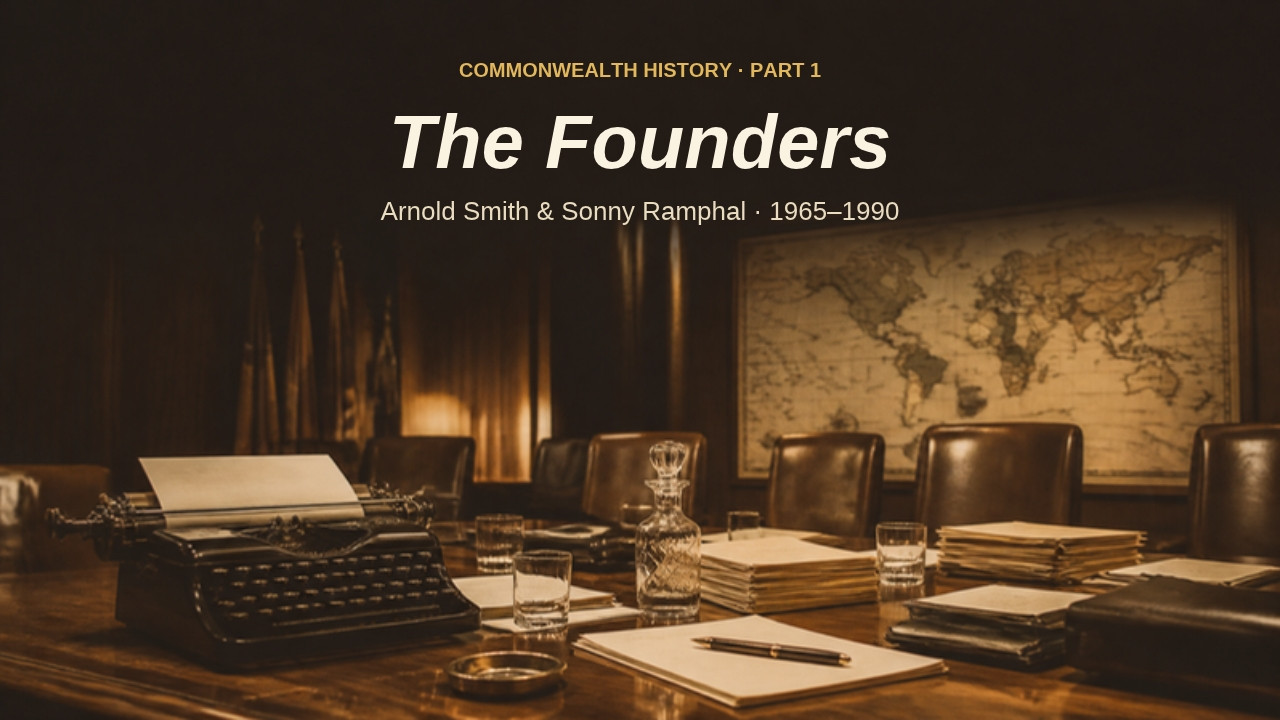
In short: Canada’s Arnold Smith (1965–1975) built the Commonwealth Secretariat from scratch and established its independence from Whitehall. Guyana’s Sir Shridath “Sonny” Ramphal (1975–1990) turned it into a moral and political force — leading the Commonwealth’s campaign against apartheid, supporting Zimbabwe’s path to independence and putting the vulnerability of small states on the global agenda.
The Commonwealth has had only seven Secretaries-General in more than six decades. The first two held the job for a quarter of a century between them, and much of what the Commonwealth is today — an association of equals with its own voice — was shaped in those years. This is the first of a CWN Times series on the people who have led the Commonwealth Secretariat.
Who was the first Commonwealth Secretary-General?
Arnold Smith, a Canadian career diplomat who had served in Moscow and Cairo, became the first Secretary-General when the Secretariat was created in 1965. He arrived to find no building of his own, a small staff and a British establishment that was not entirely comfortable with the idea of an independent Commonwealth official. For its first years, the Foreign Office did not even invite the Secretary-General to the Queen’s annual diplomatic reception — a slight the Queen herself corrected in 1968.
Smith’s quiet achievement was to establish that the Secretariat served all members, not London. That mattered enormously in his decade, as newly independent countries in Africa, Asia and the Caribbean joined and the Commonwealth’s centre of gravity moved south.
What did Arnold Smith achieve?
- Holding the club together over Rhodesia. Smith took office as white-minority Rhodesia declared unilateral independence in 1965. African members were furious with Britain’s response, and the crisis threatened to break the Commonwealth apart. Smith worked to keep the argument inside the family.
- The Singapore Declaration (1971). Leaders set out, for the first time, a shared statement of Commonwealth principles — including racial equality, opposition to colonial domination and support for representative government.
- Technical co-operation. In 1971 the Commonwealth Fund for Technical Co-operation was established, allowing members to share expertise with one another — a practical tool that still operates today.
Who was Sonny Ramphal?
Sir Shridath Surendranath Ramphal, known universally as “Sonny”, was a Guyanese lawyer and former foreign minister who served as Secretary-General from 1975 to 1990 — still the longest tenure of anyone in the post. He was the first Secretary-General from the developing world and the Caribbean, and he brought a sharp legal mind and a gift for public advocacy. He died in August 2024, aged 95, and was mourned across the Caribbean and the Commonwealth as one of its great statesmen.
How did the Commonwealth fight apartheid under Ramphal?
Ramphal made opposition to apartheid in South Africa the Commonwealth’s defining cause. Key moments included:
- The Gleneagles Agreement (1977), in which Commonwealth governments agreed to discourage sporting contact with apartheid South Africa — a powerful symbolic blow in sport-loving countries.
- The Lusaka meeting (1979), which helped lead to the Lancaster House talks and Zimbabwe’s independence in 1980.
- The Eminent Persons Group (1986), a high-level Commonwealth mission to South Africa whose findings strengthened the case for sanctions — often against the strong resistance of the British government of the day.
These were not cost-free positions. Ramphal’s Commonwealth repeatedly found itself at odds with London, and he was willing to let that tension show. Many historians credit the Commonwealth’s pressure as one of the international forces that helped bring apartheid to an end.
Why do small states owe so much to Ramphal?
Coming from a small Caribbean country, Ramphal understood that tiny island economies faced risks that large countries rarely considered: a single hurricane, a commodity price shock or an external debt crisis could wipe out years of progress. Under his leadership the Commonwealth produced influential work on the vulnerability of small states and argued for their special treatment in global economic policy. That advocacy remains one of the Commonwealth’s most distinctive contributions — today 33 of its 56 members are small states.
Ramphal was also a leading voice on the wider global stage, serving on the Brandt Commission on international development and later co-chairing the Commission on Global Governance.
How was the Secretariat created?
The decision to create a Commonwealth Secretariat was taken by prime ministers at their 1964 conference in London, and the new body was established the following year. Until then, Commonwealth meetings had been organised largely by the British government. The newly independent members of Africa, Asia and the Caribbean wanted an organisation that belonged to all of them equally — and the choice of a Canadian, rather than a Briton, as the first Secretary-General sent a clear signal about that intent.
Smith’s decade also saw the creation of practical programmes that still exist in some form today, including the Commonwealth Youth Programme, established in 1973 to support young people across member countries. After leaving office he set down his experience in a memoir, Stitches in Time: The Commonwealth in World Politics (1981), still a valuable account of how the modern Commonwealth took shape.
What other milestones came under Ramphal?
- The Lusaka Declaration on Racism and Racial Prejudice (1979), in which Commonwealth leaders committed to work for the eradication of racism.
- Global development thinking. His work on the Brandt Commission contributed to its influential 1980 report, North–South: A Programme for Survival, which argued for a fairer global economic system.
- Global governance. After leaving the Secretariat he co-chaired the Commission on Global Governance, whose 1995 report Our Global Neighbourhood set out ideas for reforming international institutions.
He remained an active public figure for decades, including in university leadership — he served as Chancellor of the University of Warwick in England and of the University of the West Indies — and as a respected adviser to Caribbean governments. When he died in 2024, tributes came from across the Commonwealth, with leaders describing him as one of the Caribbean’s greatest statesmen.
The bottom line
Smith gave the Commonwealth an institution; Ramphal gave it a conscience. Their 25 years set the template every later Secretary-General has had to live up to: independent of any one government, willing to take a stand on principle, and relentless in speaking up for the smallest members. For anyone assessing the Commonwealth’s relevance today, the founding era is a reminder of what the organisation can do when its members are united.
Frequently asked questions
Who was the first Commonwealth Secretary-General?
Arnold Smith of Canada was the first Commonwealth Secretary-General, serving from 1965 to 1975.
Who was the longest-serving Commonwealth Secretary-General?
Sir Shridath “Sonny” Ramphal of Guyana served the longest, from 1975 to 1990. Since 1993, Secretaries-General have been limited to two four-year terms.
What was the Gleneagles Agreement?
The 1977 Gleneagles Agreement was a Commonwealth commitment to discourage sporting contacts with apartheid South Africa.
Related on CWN Times: Anyaoku, McKinnon and Sharma · The Commonwealth’s greatest successes · Inside the Commonwealth Secretariat

The Diaspora Effect: How Communities Power UK–Commonwealth Trade

How the Commonwealth Secretariat Works With Governments: From CHOGM to Debt Software

AI and Payment Fraud: What UK Businesses Need to Know in 2026

Progress is Painfully Slow’: Rudolph Walker Discusses Equality for Black Actors in the Commonwealth

Vipul Jain to Be Honored at Rising Bharat Conclave 2024 in the House of Commons for Transforming Wealth Management in Tribal Communities

Commonwealth Nations Celebrate Unity and Progress Under ‘Together We Thrive’ Theme

-
 Community & Culture2 years ago
Progress is Painfully Slow’: Rudolph Walker Discusses Equality for Black Actors in the Commonwealth
-
 Community & Culture2 years ago
Vipul Jain to Be Honored at Rising Bharat Conclave 2024 in the House of Commons for Transforming Wealth Management in Tribal Communities
-
 News2 years ago
Commonwealth Nations Celebrate Unity and Progress Under ‘Together We Thrive’ Theme
-

 Community & Culture2 years ago
Sri Lanka to Host Malayalam Film Starring Mammootty and Mohanlal: A Cultural Collaboration in the Commonwealth
-

 News2 years ago
Harnessing AI for Sustainable Tourism Growth in Zimbabwe: A Commonwealth Initiative
-

 Education2 years ago
Dominican Chairman Oversees Caribbean Plant Health Directors Annual Meeting, Strengthening Commonwealth Agricultural Collaboration
-

 News2 years ago
BIMSTEC Summit 2025 Highlights Regional Cooperation Aligned with Commonwealth Development Goals
-

 News2 years ago
INS Talwar Docks in Mombasa, Strengthening Kenya-India Naval Collaboration as Part of Commonwealth Relations