
Commonwealth
Commonwealth leaders to meet in Antigua and Barbuda from 1–4 November 2026 for CHOGM summit


St John’s: Leaders from across the Commonwealth will gather in the Caribbean nation of Antigua and Barbuda for the Commonwealth Heads of Government Meeting 2026 scheduled from 1–4 November 2026 in the capital city of St John’s.
The summit will bring together Heads of Government, ministers and senior representatives from the 56 member countries of the Commonwealth, along with delegates from business communities, civil society organisations and youth groups. The meeting is regarded as the most important political gathering within the Commonwealth framework and serves as a platform for leaders to discuss common global and regional challenges.
Key issues expected to be discussed include sustainable development, climate resilience, economic cooperation, digital transformation and youth empowerment. For many small island states in the Commonwealth, climate change and environmental sustainability remain among the most pressing priorities.
Alongside the main leaders’ meeting, several parallel forums will be held, including business, youth and civil society forums aimed at strengthening collaboration between governments and communities across Commonwealth countries.
Hosting the summit is a significant diplomatic opportunity for Antigua and Barbuda, highlighting its role within the Commonwealth community and allowing the Caribbean nation to showcase its leadership on global issues.
Officials say the meeting will strengthen dialogue and cooperation among Commonwealth countries while promoting shared values of development, democracy and international partnership.

Commonwealth
Cricket Diplomacy: How Sport Opens Doors for Commonwealth Business
From a cricket ground hosting the Commonwealth Business Forum to a cricket legend as summit envoy, sport sits at the heart of CHOGM 2026. Why sport remains one of the Commonwealth’s most powerful business connectors.

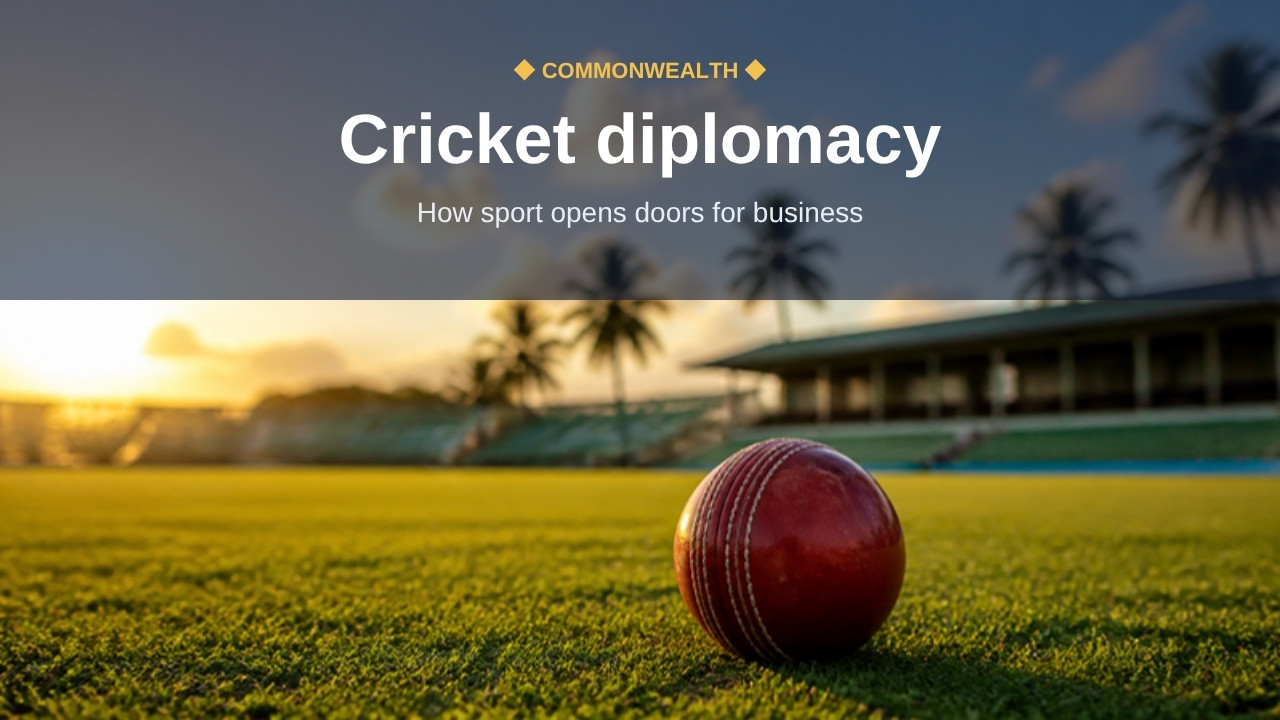
In short: At CHOGM 2026 in Antigua and Barbuda, cricket is more than a backdrop. Sir Vivian Richards is the summit’s envoy, the Commonwealth Business Forum is being held at the Sticky Wicket cricket ground, and a Commonwealth cricket celebration is part of the official programme. Sport builds the trust that trade depends on — and that makes it a serious business asset.
Ask anyone who has worked across the Commonwealth and they will tell you: conversations often start with cricket. A shared love of the game breaks the ice in boardrooms from London to Mumbai, Bridgetown to Johannesburg. It is no accident that the 2026 Commonwealth summit has put the sport front and centre.
How is cricket part of CHOGM 2026?
Antigua and Barbuda appointed cricket legend Sir Vivian Richards as CHOGM 2026 Envoy. “Cricket has always been much more than a game across the Commonwealth,” he said, describing how it would help bring the summit’s spirit to life by “creating opportunities to work together as one team”.
The Commonwealth Business Forum, which brings ministers and investors together from 2 to 4 November, is being held at the Sticky Wicket cricket ground, and Cricket West Indies is staging a Commonwealth cricket celebration as part of the summit programme. Weeks earlier, Ahmedabad hosted the first Commonwealth Kabaddi Championship — a sign that the Commonwealth’s sporting calendar is widening too.
Why does sport matter for business?
- Trust before transactions. Deals follow relationships, and few things build relationships faster than shared passion.
- Soft power. Sport shapes how countries see each other, opening doors for investment, tourism and education.
- A growing industry in its own right. Broadcasting, sponsorship, academies, venues, events and sports technology are serious commercial sectors across the Commonwealth.
- Community and inclusion. Grassroots and disability sport connect diaspora communities and give businesses meaningful ways to contribute.
How can businesses use sport as a bridge?
For UK firms looking at Commonwealth markets, sport offers practical routes in: hospitality at international fixtures, partnerships with academies and community programmes, sponsorship tied to trade events, and collaboration with sports bodies on facilities, technology and events. The key is authenticity — partnerships that genuinely support the game and its communities earn far more goodwill than logos on a hoarding.
Has sport shaped Commonwealth politics before?
Very much so. One of the Commonwealth’s most important political decisions was about sport. In the 1977 Gleneagles Agreement, Commonwealth governments agreed to discourage sporting contact with apartheid South Africa. In cricket- and rugby-loving countries, the isolation was felt keenly, and it became one of the most visible forms of international pressure on the apartheid system. When South Africa returned to the international game in the early 1990s, it marked one of the clearest signs that the country was changing.
Cricket also carries a unique form of regional unity in the Caribbean. The West Indies team draws players from a group of independent countries and territories that otherwise compete as separate nations — a rare example of sport creating a shared identity across borders.
How big is the business of cricket?
Cricket has become one of the most valuable sports properties in the world, largely thanks to the Twenty20 format and India’s enormous audience. The broadcast rights for the Indian Premier League for 2023 to 2027 were sold for around ₹48,390 crore — roughly US$6 billion — placing it among the most valuable sports leagues globally on a per-match basis. Franchise leagues now run in several Commonwealth countries, including the Caribbean, South Africa, Australia and the UK, with team owners, sponsors and broadcasters investing across borders.
The game’s global profile is set to grow further: cricket will return to the Olympic Games at Los Angeles 2028 for the first time since 1900. And the West Indies co-hosted the 2024 ICC Men’s T20 World Cup with the United States, showing how the Caribbean continues to use major events to attract visitors and investment.
What about the Commonwealth Games?
The Commonwealth Games remain the organisation’s best-known sporting event. They began as the British Empire Games in Hamilton, Canada, in 1930, and are notable for including para-sport events in the same programme as other events. Business forums are often held alongside the Games: the Commonwealth Enterprise and Investment Council ran a Commonwealth Games Business Forum during Birmingham 2022, linking the sporting spotlight to trade and investment. Glasgow was chosen to host the 2026 Games in a more compact format, returning to the city that staged them in 2014.
The bottom line
The Commonwealth’s shared language and legal systems make trade easier on paper. Sport makes it easier in person. Holding a business forum at a cricket ground is a reminder that, across these 56 countries, relationships are still built one conversation — and one match — at a time.
Frequently asked questions
Who is the CHOGM 2026 envoy?
Antigua and Barbuda appointed cricket legend Sir Vivian Richards as the CHOGM 2026 Envoy.
Where is the Commonwealth Business Forum 2026 held?
The 14th Commonwealth Business Forum takes place from 2 to 4 November 2026 at the Sticky Wicket cricket ground in Antigua and Barbuda.
What is sports diplomacy?
Sports diplomacy is the use of sport to build relationships and understanding between countries, which can support trade, investment, tourism and cultural ties.
Related on CWN Times: CHOGM 2026 opens in Antigua with investment at the top of the agenda · What is the Commonwealth?
Commonwealth
Inside the Commonwealth Secretariat: How the 56-Nation Club Is Run from London
From a historic house on Pall Mall, a small international organisation serves 56 countries and 2.7 billion people. Who runs the Commonwealth Secretariat, who pays for it, and what does it actually do?
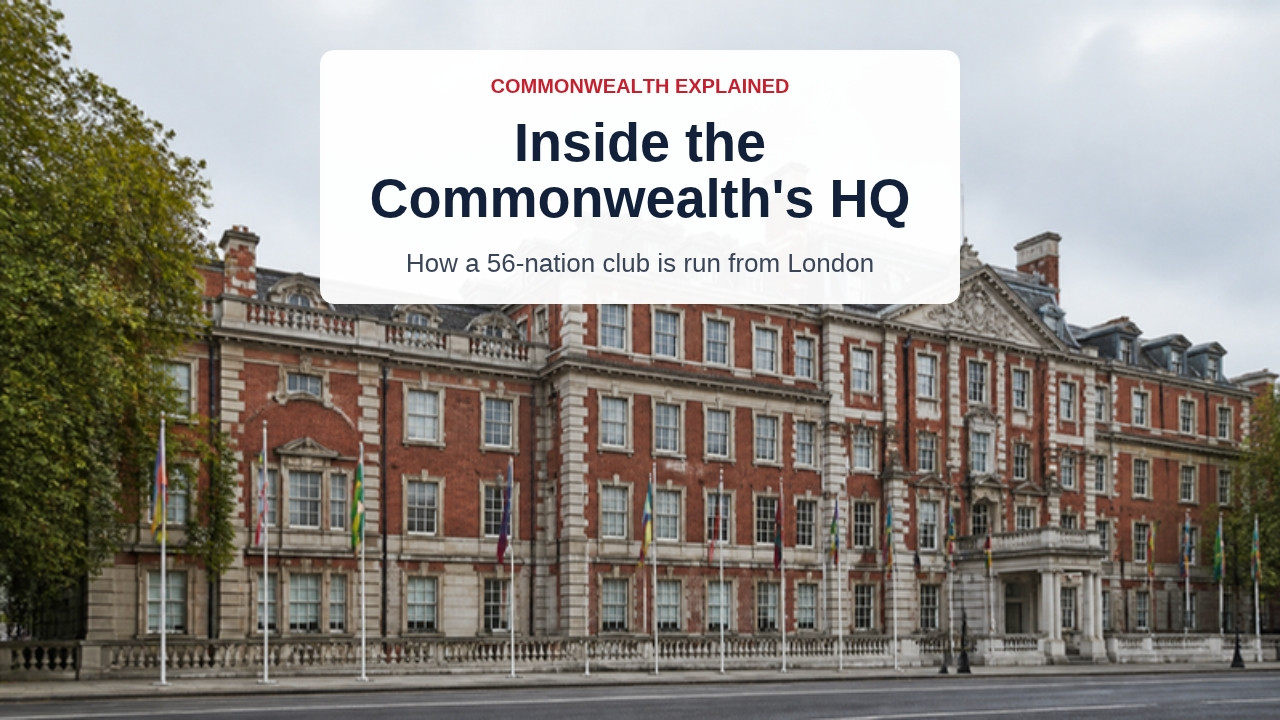
In short: The Commonwealth Secretariat is the intergovernmental body that turns the decisions of 56 member countries into practical work. Founded in 1965 and based at Marlborough House on Pall Mall, London, it is led by a Secretary-General, overseen by a Board of Governors made up of member countries’ High Commissioners, and funded mainly by member governments. Its priorities are set by leaders at the Commonwealth Heads of Government Meeting (CHOGM) every two years.
Most people know the Commonwealth through the Commonwealth Games, the King’s Commonwealth Day message or the summit photographs of leaders lined up in the sunshine. Far fewer know about the organisation that keeps the whole enterprise running between those moments. The Commonwealth Secretariat is small by the standards of international bodies, yet it serves a family of 56 countries that is home to around 2.7 billion people — roughly a third of humanity.
What is the Commonwealth Secretariat?
The Secretariat is the Commonwealth’s main intergovernmental agency. It was created by Commonwealth prime ministers in 1965, at a time when decolonisation was rapidly adding new independent members and the old model — in which Britain’s Commonwealth Relations Office effectively hosted the club — no longer worked. Leaders wanted an organisation that belonged to all members equally, with its own staff and its own head.
That principle still matters. The Secretariat is not an arm of the British government, even though it sits a short walk from Downing Street. It answers to all 56 members, and its Secretary-General is chosen by heads of government collectively.
Why is it based at Marlborough House?
Marlborough House, built in the early 1700s to a design by Sir Christopher Wren for Sarah, Duchess of Marlborough, was a royal residence for much of its history. Queen Elizabeth II placed it at the disposal of the British government for use as a Commonwealth centre, and it has housed the Secretariat since 1965. It is also home to the Commonwealth Foundation, the sister organisation that works with civil society.
The building gives the Commonwealth a distinctive diplomatic stage in London — a neutral meeting place where ministers, High Commissioners and officials from Africa, Asia, the Caribbean, the Pacific, Europe and the Americas can meet as equals.
Who runs the Secretariat?
Day to day, the Secretariat is led by the Secretary-General, currently Shirley Botchwey of Ghana, who took office on 1 April 2025. The Secretary-General is supported by deputy secretaries-general and a professional staff drawn from across member countries.
Oversight comes from three levels:
- Heads of government set the overall direction at CHOGM, held every two years, and elect the Secretary-General for terms of four years, with a maximum of two terms.
- The Board of Governors, made up of member countries’ High Commissioners in London, usually meets once a year to approve the Secretariat’s strategic plan, work programme and budget.
- The Executive Committee of the Board meets more frequently to scrutinise performance, finances and delivery between Board meetings.
In September 2025 the Board approved the Secretariat’s Strategic Plan 2025–2030, built on three pillars: democratic resilience, economic resilience and environmental resilience, with young people, women and small states as cross-cutting priorities.
Who pays for the Commonwealth Secretariat?
Member governments do. Each country pays an assessed contribution to the core budget, calculated broadly according to its capacity to pay, so larger and wealthier economies such as the UK, Canada and Australia carry the biggest shares while small island states pay modest amounts. On top of this, governments can make voluntary contributions to specific funds, most notably the Commonwealth Fund for Technical Co-operation (CFTC), set up in 1971 to share expertise between members.
This funding model means every member has a stake in the Secretariat’s success, from the largest economies to the smallest island states.
What does the Secretariat actually do?
Its work falls into a few broad areas:
- Democracy and governance — observing elections, supporting parliaments, strengthening the rule of law and human rights institutions.
- Trade and economic development — advising governments on trade negotiations, investment and the “Commonwealth advantage” of shared language and legal systems.
- Debt and public finance — through its Commonwealth Meridian software and advisory teams, it helps finance ministries record and manage public debt.
- Climate and oceans — through the Commonwealth Climate Finance Access Hub, which places advisers inside governments to help them secure climate finance, and the Commonwealth Blue Charter on ocean protection.
- Small states advocacy — 33 of the 56 members are small states, and the Secretariat champions their interests in global forums.
- Convening — organising CHOGM and regular meetings of finance, law, health, education, trade, foreign and other ministers.
How is it different from other Commonwealth organisations?
The Commonwealth is a wider family than the Secretariat alone. The Commonwealth Foundation supports civil society; the Commonwealth of Learning, based in Canada, promotes open and distance education; and dozens of accredited professional and civil society bodies — from lawyers and journalists to local government and universities — carry the Commonwealth name. The Commonwealth Games Federation, which runs the Games, is separate again. The Secretariat is the one that works directly for governments.
Which countries does the Secretariat serve?
The Secretariat works for all 56 members, spread across every inhabited continent:
| Region | Members |
|---|---|
| Africa | 21 |
| Asia | 8 |
| Caribbean and Americas | 13 |
| Europe | 3 |
| Pacific | 11 |
Members range from India, with well over a billion people, to Nauru and Tuvalu, with populations of around 10,000. That spread is one of the Secretariat’s biggest challenges: it has to be useful to some of the world’s largest economies and to some of its smallest states at the same time.
Does the Secretariat work outside London?
Yes. Small countries often cannot afford full diplomatic missions in the world’s main negotiating centres, so the Commonwealth runs Small States Offices in Geneva and New York. They give member countries without a permanent presence subsidised office space and support, helping them take part in negotiations at the United Nations, the World Trade Organization and other bodies. Secretariat staff and advisers also work directly in member countries on specific programmes, such as the climate finance advisers placed inside governments.
How can businesses and organisations engage with it?
The Secretariat works mainly with governments, but there are several ways for others to connect with its work. Professional associations, universities and civil society bodies can apply for accreditation, which gives them a recognised relationship with the Commonwealth. Businesses usually engage through the Commonwealth Enterprise and Investment Council, which runs the Commonwealth Business Forum alongside each CHOGM, and through programmes such as the Commonwealth Investment Platform, launched in October 2026 to showcase investment-ready projects from member countries.
The Secretariat also publishes a large body of research and policy work through its online library, covering trade, debt, oceans, law and governance. For anyone researching a Commonwealth market, it is a useful and often overlooked resource.
When is the Commonwealth most visible?
Beyond CHOGM, the most visible moment in the Commonwealth calendar is Commonwealth Day, held on the second Monday of March each year, with a service at Westminster Abbey and celebrations across member countries. The Secretariat co-ordinates the theme each year; in 2026 it was “Unlocking opportunities for a prosperous Commonwealth”.
The bottom line
The Commonwealth Secretariat is a lean organisation with an outsized network. Its influence rarely comes from money or power; it comes from convening — getting finance ministers, trade officials and leaders from very different countries into the same room, in a shared language, under shared rules. For businesses and policymakers in the UK, understanding how Marlborough House works is the first step to using the Commonwealth network well.
Frequently asked questions
Where is the Commonwealth Secretariat based?
The Commonwealth Secretariat is headquartered at Marlborough House on Pall Mall in London, where it has been based since it was founded in 1965.
Is the Commonwealth Secretariat part of the UK government?
No. It is an intergovernmental organisation that serves all 56 member countries equally. Its Secretary-General is elected by Commonwealth heads of government.
How is the Commonwealth Secretariat funded?
Mainly through assessed contributions from member governments, scaled to their capacity to pay, plus voluntary contributions to funds such as the Commonwealth Fund for Technical Co-operation.
Related on CWN Times: How the Secretariat works with governments · The founding Secretaries-General · CHOGM 2026 opens in Antigua
Business
CHOGM 2026 Opens in Antigua With Investment at the Top of the Agenda
The 28th Commonwealth Heads of Government Meeting opens in St John’s, Antigua and Barbuda, under the theme “Accelerating Partnerships and Investment for a Prosperous Commonwealth”, with a business forum and a new pipeline of investment-ready projects.
London, UK — 1 November 2026
Key points: Leaders from the Commonwealth’s 56 member countries gather in St John’s, Antigua and Barbuda, from 1 to 4 November for the 28th Commonwealth Heads of Government Meeting (CHOGM). This year’s theme puts business first — “Accelerating Partnerships and Investment for a Prosperous Commonwealth” — backed by a Commonwealth Business Forum and a new platform of more than 60 investment-ready projects.
The 28th Commonwealth Heads of Government Meeting opens today in St John’s, the capital of Antigua and Barbuda, bringing together heads of government, ministers and representatives from business, civil society and youth organisations. Antigua and Barbuda is the smallest country ever to host CHOGM, and the summit coincides with the nation’s 45th anniversary of independence on 1 November.
It is also the first CHOGM convened by Commonwealth Secretary-General Shirley Botchwey, who took office in April 2025. “The world is changing and CHOGM 2026 is our moment to shape what comes next,” she said ahead of the summit.
Why is this CHOGM focused on investment?
The theme, “Accelerating Partnerships and Investment for a Prosperous Commonwealth”, reflects a deliberate shift towards practical economic outcomes. According to the Commonwealth Secretariat, CHOGM 2026 will for the first time bring government and business leaders together specifically to unlock investment.
On 20 October the Secretariat launched the Commonwealth Investment Platform, showcasing more than 60 high-impact projects submitted by 20 Commonwealth countries that are seeking financing. The Secretary-General has made support for small states, least developed countries and other vulnerable economies a key pillar of her leadership.
Host Prime Minister Gaston Browne set the tone at the summit’s launch: “Antigua and Barbuda is proud to open our doors to the Commonwealth in 2026 — to host, to listen, and to lead with purpose.”
What happens at the Commonwealth Business Forum?
The 14th Commonwealth Business Forum runs from 2 to 4 November at the Sticky Wicket cricket ground, hosted by the Commonwealth Enterprise and Investment Council (CWEIC) with the Government of Antigua and Barbuda and the Commonwealth Secretariat. CWEIC expects more than 900 delegates, including representatives of Afreximbank, the International Monetary Fund, the World Trade Organization, Royal Bank of Canada, De La Rue and Fortescue.
CWEIC describes the Commonwealth as a market of 2.7 billion people with a combined GDP of more than US$13 trillion, and says the cost of doing business between member countries is on average 21% lower, thanks to shared language, legal systems and regulatory traditions. The forum includes a business-matching system for pre-arranged one-to-one meetings, aimed at turning high-level discussion into deals.
King Charles III, as Head of the Commonwealth, will address the summit’s opening ceremony on 3 November and is also due to attend the Business Forum. Alongside the leaders’ meetings, the programme includes Youth, Women’s and People’s Forums.
What else is on the table?
UK Prime Minister Andy Burnham is attending. Caribbean leaders are expected to raise slavery and reparatory justice, although these are not formally on the agenda. Mr Burnham has said he is open to hearing calls for a formal apology but has ruled out financial reparations, a position Caribbean leaders have rejected.
Sudeep Sakalle’s take
“For UK businesses, the value of CHOGM is less in the communiqué and more in the room. A summit built around a live pipeline of investment-ready projects — with development banks, multilaterals and private investors at the same table — is a practical opening for British firms in infrastructure, fintech, digital services and professional services. Coming just months after the UK–India trade agreement took effect, it is a reminder that the Commonwealth’s shared language and legal systems still lower the cost of doing business. The firms that arrive prepared, with a clear offer and local partners, are the ones that will benefit.”
— Sudeep Sakalle, Business Leader & Strategic Adviser
Frequently asked questions
When and where is CHOGM 2026?
CHOGM 2026 takes place from 1 to 4 November 2026 in St John’s, Antigua and Barbuda. It is the 28th meeting of Commonwealth Heads of Government.
What is the theme of CHOGM 2026?
The theme is “Accelerating Partnerships and Investment for a Prosperous Commonwealth”, focusing on collaboration, sustainable investment and shared prosperity across the 56 member countries.
Can businesses take part in CHOGM 2026?
Yes. The Commonwealth Business Forum, run by the Commonwealth Enterprise and Investment Council from 2 to 4 November, brings together business leaders, investors and ministers, with pre-arranged one-to-one business meetings.
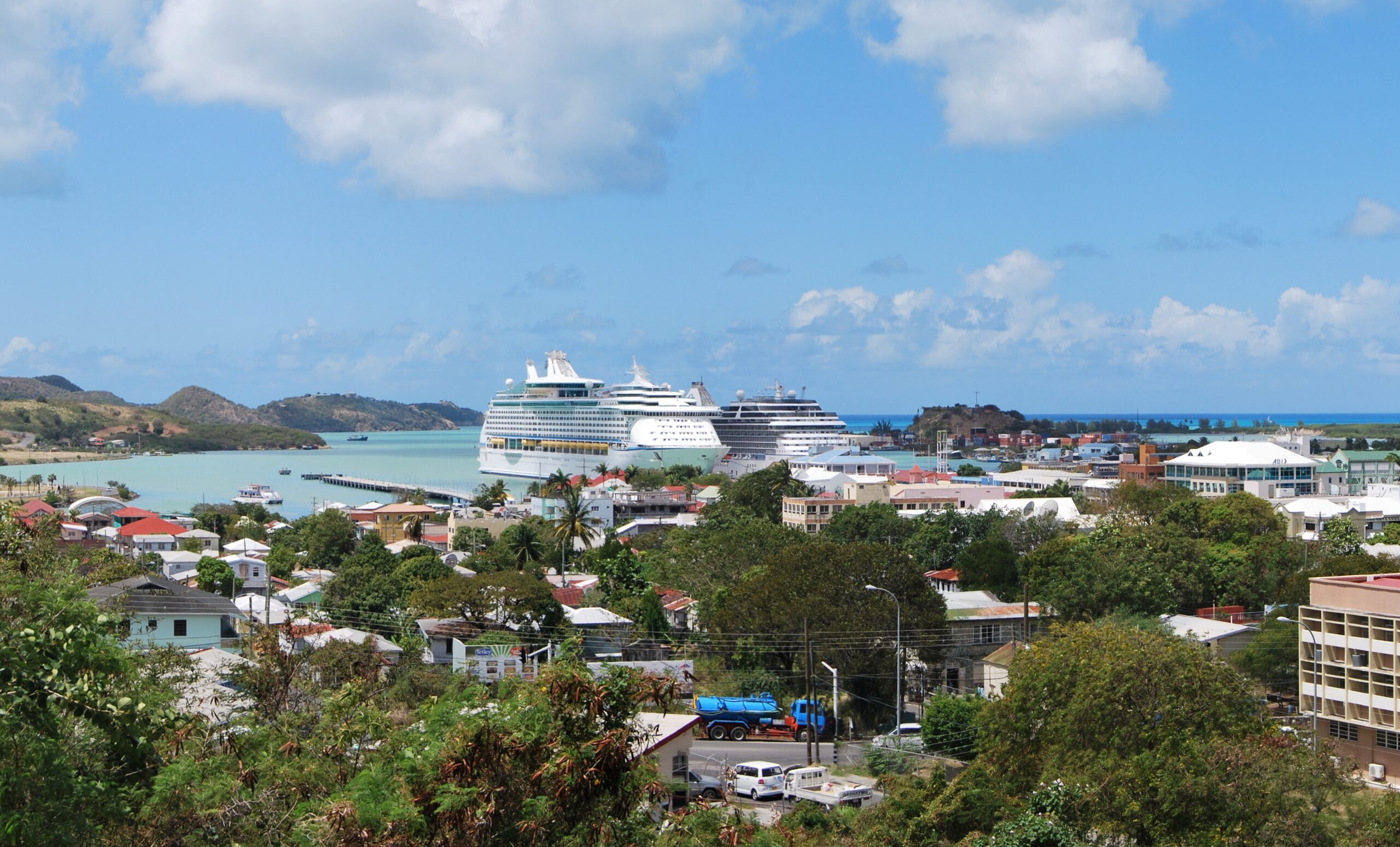
Featured image: St John’s harbour, Antigua. Photo via Wikimedia Commons, openly licensed.
Related on CWN Times: India–UK sign historic CETA · CHOGM 2024 closing ceremony

Cricket Diplomacy: How Sport Opens Doors for Commonwealth Business

Inside the Commonwealth Secretariat: How the 56-Nation Club Is Run from London

Card Processing Fees in the UK: A Plain-English Guide for Small Businesses

Progress is Painfully Slow’: Rudolph Walker Discusses Equality for Black Actors in the Commonwealth

Vipul Jain to Be Honored at Rising Bharat Conclave 2024 in the House of Commons for Transforming Wealth Management in Tribal Communities

Commonwealth Nations Celebrate Unity and Progress Under ‘Together We Thrive’ Theme

-
 Community & Culture2 years ago
Progress is Painfully Slow’: Rudolph Walker Discusses Equality for Black Actors in the Commonwealth
-
 Community & Culture2 years ago
Vipul Jain to Be Honored at Rising Bharat Conclave 2024 in the House of Commons for Transforming Wealth Management in Tribal Communities
-
 News2 years ago
Commonwealth Nations Celebrate Unity and Progress Under ‘Together We Thrive’ Theme
-

 Community & Culture2 years ago
Sri Lanka to Host Malayalam Film Starring Mammootty and Mohanlal: A Cultural Collaboration in the Commonwealth
-

 News2 years ago
Harnessing AI for Sustainable Tourism Growth in Zimbabwe: A Commonwealth Initiative
-

 News2 years ago
BIMSTEC Summit 2025 Highlights Regional Cooperation Aligned with Commonwealth Development Goals
-

 Education2 years ago
Dominican Chairman Oversees Caribbean Plant Health Directors Annual Meeting, Strengthening Commonwealth Agricultural Collaboration
-

 News2 years ago
INS Talwar Docks in Mombasa, Strengthening Kenya-India Naval Collaboration as Part of Commonwealth Relations