
Commonwealth
CHOGM 2026: What Commonwealth Leaders Agreed in Antigua
From a structured reparations dialogue with the UK to debt reform, a new Commonwealth Trade Portal and AI skills, here is what leaders agreed at CHOGM 2026 in St John’s, Antigua and Barbuda.


For four days, St John’s became the centre of the Commonwealth. Leaders and ministers from the organisation’s 56 member countries, which are home to about 2.7 billion people, met from 1 to 4 November under the theme “Accelerating Partnerships and Investment for a Prosperous Commonwealth”. Antigua and Barbuda, with fewer than 100,000 people, became the smallest country ever to host a CHOGM, and the summit was the first convened by Secretary-General Shirley Botchwey, who took office in April 2025.
The final communiqué is long and wide-ranging. Read closely, it is one of the most business-focused texts a Commonwealth summit has produced, while also taking a first structured step on the most sensitive issue on the agenda: reparatory justice for the transatlantic slave trade.
What did leaders agree on reparations?
Reparations dominated the build-up. Host Prime Minister Gaston Browne had called for a Commonwealth framework on the issue, and CARICOM leaders wanted it placed prominently on the agenda. In the end, leaders welcomed the United Kingdom’s agreement to enter talks with affected parties on the transatlantic slave trade and its consequences. The communiqué describes the proposed dialogue as “structured, time-bound, inclusive and good-faith”.
The language is carefully limited. The text does not create a compensation mechanism or commit any country to payments, and no start date, venue or format for the talks has yet been published. It builds on the 2024 summit in Samoa, where leaders agreed the time had come for a “meaningful, truthful and respectful conversation”, and it notes work since then by the African Union and CARICOM on reparatory justice and the return of cultural heritage. It also records a UN General Assembly resolution describing the trafficking and enslavement of Africans as “the gravest crime against humanity”.
The issue was also at the heart of King Charles III’s address at the opening session on 3 November. The King spoke of his “horror” and “the most profound personal sorrow” at the slave trade, but did not apologise. Before the summit, UK Prime Minister Andy Burnham said the UK was open to a formal apology but ruled out financial reparations, proposing instead to lead a debt restructuring programme for the Commonwealth’s poorest countries.
What changes on finance and debt?
For many of the Commonwealth’s 33 small states, the most important part of the communiqué is on money. Leaders called for reform of the international financial system so that small island developing states, least developed countries and landlocked developing countries can reach affordable finance. They backed debt frameworks that take climate vulnerability into account, including clauses that allow countries to pause repayments after major crises such as hurricanes.
The text also supports mobilising private investment, stronger domestic revenue collection and action against illicit financial flows. These are long-running Commonwealth demands, but they carry more weight this time because a UK proposal on debt restructuring for the poorest members is now on the table.
What does the summit mean for trade and investment?
Trade was the heart of the summit theme. Members agreed to work on easing unnecessary barriers to trade in goods and services between them, reaffirmed support for the World Trade Organization and its reform, and welcomed the launch of a new Commonwealth Trade Portal. The communiqué also encourages processing critical minerals in the countries that mine them, so that more of the value stays at home, and gives particular attention to small businesses owned by women and young people.
Investment ran alongside trade. Ahead of the summit, on 20 October, the Commonwealth Secretariat launched a Commonwealth Investment Platform featuring more than 60 investment-ready projects from 20 member countries, worth around US$30 billion across energy, transport, agriculture, manufacturing and the green economy. Figures from the Secretariat’s 2026 Commonwealth Trade Review put combined Commonwealth GDP at US$15.9 trillion in 2025, rising to a projected US$20 trillion by 2029.
What did leaders commit to on AI and digital?
Leaders agreed to expand digital infrastructure and build digital and AI skills across the membership, and to develop safeguards on cybersecurity, data protection and harms from artificial intelligence. They highlighted support for developing countries that lack the computing capacity to take part in the AI economy, a gap that risks widening the divide between richer and poorer members.
What about climate and energy?
The communiqué reaffirms the Paris Agreement goal of limiting warming to 1.5°C and the global targets to triple renewable energy capacity and double the rate of energy-efficiency improvements by 2030. Leaders called for more climate finance and a transition away from fossil fuels, while acknowledging that members start from very different economic positions. For low-lying Caribbean and Pacific members, climate remains an immediate economic and security issue.
What did leaders say on democracy and security?
Leaders expressed concern about restrictions on journalists, human rights defenders and civil society, and warned against using laws to criminalise legitimate activity. They backed a stronger Commonwealth Ministerial Action Group, the body that monitors serious breaches of Commonwealth values, and plans for an early warning system on risks to democracy and institutions.
On peace and security, they supported international law and the peaceful settlement of disputes, called for the protection of humanitarian workers, and reaffirmed support for the sovereignty and territorial integrity of Belize, Guyana and Cyprus. They also called for continued help for more than 1.2 million displaced Rohingya and for conditions that would allow their safe return to Myanmar.
Who attended?
King Charles III attended as Head of the Commonwealth, as part of a Caribbean tour that also took in the Bahamas and Guyana. Prime Minister Gaston Browne chaired the meeting. Leaders present included UK Prime Minister Andy Burnham, Australian Prime Minister Anthony Albanese and Canadian Prime Minister Mark Carney. Alongside the main summit, business, youth, women’s and people’s forums brought together delegates from across the membership.
What happens next?
Three things will show whether Antigua delivers. The first is how the UK-led reparations dialogue is designed: who takes part, how long it lasts and what it can produce. The second is whether reform of debt and finance for small states moves forward in international bodies such as the IMF and World Bank, where the Commonwealth has influence but not control. The third is whether the projects on the Investment Platform reach financial close and the Trade Portal becomes a tool businesses actually use. For UK firms, the trade and investment commitments are the most practical outcome: a vetted pipeline of projects and a political push to make trade between Commonwealth members easier.


Commonwealth
King Charles Voices ‘Profound Sorrow’ Over Slavery at CHOGM, Stops Short of Apology
Opening CHOGM 2026 in Antigua, King Charles III spoke of “horror” and “the most profound personal sorrow” over the transatlantic slave trade, but did not apologise. Here is what he said and how leaders responded.
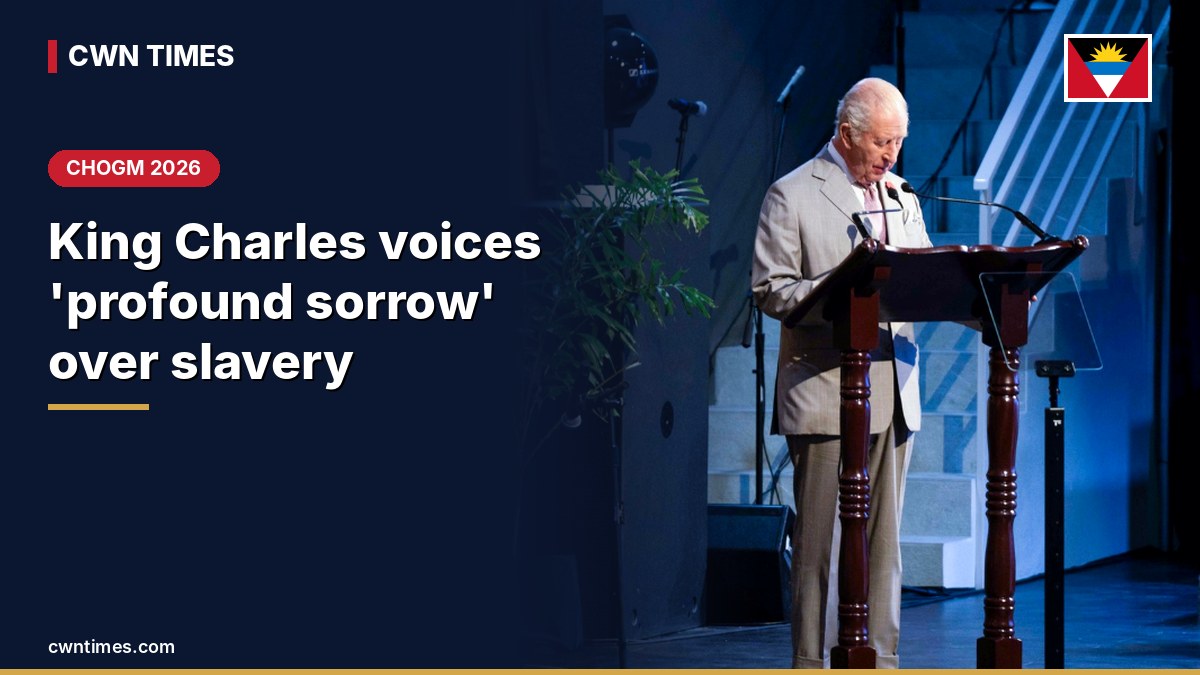
Few moments at the Antigua summit were watched as closely as the King’s opening address. Speaking at the National Performing Arts Centre in St John’s, in front of leaders from the Commonwealth’s 56 member countries, he chose to confront the history of slavery directly, in the region where its legacy is felt most strongly.
The speech came at the end of months of pressure. Caribbean governments, the CARICOM Reparations Commission and campaigners across the region had called for reparatory justice to be at the centre of the summit. Host Prime Minister Gaston Browne had called for a Commonwealth framework on the issue. The King’s words were always going to be read as a signal of how far Britain was prepared to go.
What did King Charles say?
The King described the transatlantic slave trade as something that filled him with “horror” and “the most profound personal sorrow”. He said it “still casts a shadow over these islands and other members of our Commonwealth”. He also noted that the Royal Navy had played “a leading role” in ending the trade after its abolition.
On the question of what should follow, he said: “We cannot change the actions of those who came before us. We can, however, learn from the past.” He then turned to the future, pointing to better education, investment in jobs, more trade between Commonwealth members and stronger climate resilience as the ways the Commonwealth could build shared prosperity.
How does this compare with what he has said before?
The King has spoken about slavery on several occasions. At CHOGM in Kigali in 2022, he spoke of his personal sorrow at the suffering it caused. At the 2024 summit in Samoa, he acknowledged that “none of us can change the past” while saying the Commonwealth could commit to learning its lessons. The Antigua speech used some of his strongest language yet, but it followed the same line: acknowledgement and regret, without an apology.
Why was there no apology?
Buckingham Palace made clear before the Caribbean tour, which also included visits to the Bahamas and Guyana, that no formal apology would be issued. As a constitutional monarch, the King speaks on matters of this kind in line with the advice of the UK government.
The government’s position shifted in the days before the summit. UK Prime Minister Andy Burnham said the UK was open to a formal apology but ruled out financial reparations. Writing in The Guardian, he said he wanted to “express my sorrow and regret for the pain and suffering of so many millions of people”. He also proposed that the UK lead a debt restructuring programme for the Commonwealth’s poorest countries, a move many saw as an attempt to offer something practical without accepting the principle of compensation.
How did Caribbean leaders respond?
Responses were measured but clear. Guyana’s President Mohamed Irfaan Ali said an apology should be the King’s next step. Antigua and Barbuda’s Prime Minister Gaston Browne, chairing the summit, said no nation should have to sacrifice its future just to survive the present, a reference to the debt and climate pressures facing small Caribbean economies.
Outside the venue, protesters carried signs reading “Acknowledge the wrong. Commit to repair.” An Antiguan resident quoted by Al Jazeera said that while people are free in law, many do not yet feel free, and that an apology is where repair begins.
What did the summit agree in the end?
By the time the summit closed on 4 November, leaders had welcomed the UK’s agreement to enter talks with affected parties on the slave trade and its consequences. The communiqué describes the dialogue as “structured, time-bound, inclusive and good-faith”. It does not set up any compensation mechanism or commit to payments, and no timetable for the talks has yet been published.
That outcome reflects the balance of the week. The King’s words acknowledged the scale of the harm. The UK government signalled it might apologise but would not pay. Caribbean and African leaders secured a formal process, which they had not had before, even if its scope is still open.
What happens next?
Attention now moves from the King’s words to the government’s actions. The key questions are whether the UK follows through on a formal apology, how the promised dialogue is organised and who takes part, and whether the proposed debt restructuring for the poorest members becomes part of the wider settlement. For many in the Caribbean, the speech in St John’s was a step forward in tone. Whether it becomes a step forward in substance will depend on the talks that follow.
Commonwealth
Anyaoku, McKinnon and Sharma: The Secretaries-General Who Made Democracy the Commonwealth’s Test
From Nelson Mandela’s South Africa rejoining to the Commonwealth Charter, three Secretaries-General from Nigeria, New Zealand and India steered the Commonwealth from 1990 to 2016.

In short: Between 1990 and 2016 three Secretaries-General — Chief Emeka Anyaoku of Nigeria (1990–2000), Don McKinnon of New Zealand (2000–2008) and Kamalesh Sharma of India (2008–2016) — turned democracy and good governance into the Commonwealth’s membership test. Their era brought the Harare Declaration, South Africa’s return, a mechanism to suspend errant members, and the 2013 Commonwealth Charter.
After the anti-apartheid struggle of the 1970s and 1980s, the Commonwealth faced a new question: what does it stand for when the Cold War is over and almost every member is independent? The answer, developed over 26 years under three very different leaders, was values — democracy, the rule of law and human rights — backed for the first time by consequences.
What did Emeka Anyaoku achieve?
Chief Emeka Anyaoku, a Nigerian diplomat who had spent most of his career inside the Secretariat, became the first African Secretary-General in 1990. His decade was defined by three things:
- The Harare Declaration (1991), which committed members to democracy, the rule of law, human rights and good governance.
- South Africa’s return. Anyaoku worked closely with all sides during the transition from apartheid, and in 1994 Nelson Mandela’s South Africa rejoined the Commonwealth it had left in 1961.
- The Millbrook Programme (1995), which created the Commonwealth Ministerial Action Group to deal with members that seriously violated those values. Its first major test was Anyaoku’s own country: Nigeria was suspended in 1995 after the execution of Ken Saro-Wiwa and eight other activists, and readmitted in 1999 after the return to civilian rule.
His tenure also saw Mozambique join in 1995 — the first member with no historical constitutional link to Britain, opening the door to a wider Commonwealth.
How did Don McKinnon handle Zimbabwe?
Don McKinnon, a former New Zealand deputy prime minister and foreign minister, took over in 2000. His defining challenge was Zimbabwe. After disputed elections and political violence, Zimbabwe was suspended in 2002. When leaders decided at the 2003 CHOGM in Abuja to maintain the suspension, President Robert Mugabe withdrew Zimbabwe from the Commonwealth altogether.
The episode split opinion, with some African members sympathetic to Harare. A bid backed by Zimbabwe to replace McKinnon at the 2003 summit failed — he was re-elected by 40 votes to 11. McKinnon also dealt with repeated crises in Fiji and pushed for stronger Commonwealth election observation.
What is Kamalesh Sharma’s legacy?
Kamalesh Sharma, a senior Indian diplomat and former High Commissioner to the UK, served from 2008 to 2016. His tenure brought:
- The Commonwealth Charter (2013) — for the first time, a single document setting out the Commonwealth’s core values, from democracy and human rights to sustainable development and gender equality.
- Rwanda’s accession in 2009, the second member with no colonial link to Britain.
- Fiji’s full suspension in 2009 following its military government’s refusal to hold elections, and its restoration in 2014 after polls.
- A 2011 Eminent Persons Group report urging reform to keep the Commonwealth relevant.
Sharma also faced criticism. Rights groups and some member governments argued that the Secretariat was too cautious in speaking out, particularly around the 2013 CHOGM in Sri Lanka, which several leaders chose not to attend over human rights concerns. The Gambia left the Commonwealth in 2013, calling it a “neo-colonial institution” — though it rejoined in 2018.
What happened to them after the Secretariat?
All three remained active in public life. Chief Emeka Anyaoku returned to Nigeria and became one of the country’s most respected elder statesmen, frequently speaking on national unity and governance. Don McKinnon went back to New Zealand and recorded his years at the Secretariat in a memoir, In the Ring: A Commonwealth Memoir. Kamalesh Sharma combined diplomacy with academic leadership, serving as Chancellor of Queen’s University Belfast.
How did the Commonwealth change between 1990 and 2016?
| Year | Milestone |
|---|---|
| 1991 | Harare Declaration commits members to democracy and good governance |
| 1994 | South Africa rejoins the Commonwealth |
| 1995 | Millbrook Programme creates CMAG; Mozambique joins |
| 2003 | Zimbabwe leaves after its suspension is maintained |
| 2009 | Rwanda joins |
| 2011 | Eminent Persons Group reports on Commonwealth reform |
| 2013 | Commonwealth Charter adopted |
Taken together, these years turned the Commonwealth from an association bound mainly by history into one with written values, a mechanism for upholding them, and a growing membership that included countries with no colonial link to Britain.
Commonwealth
The Diaspora Effect: How Communities Power UK–Commonwealth Trade
Millions of Britons have roots across the Commonwealth. Their networks, knowledge and trust are among the UK’s most underused trade assets.
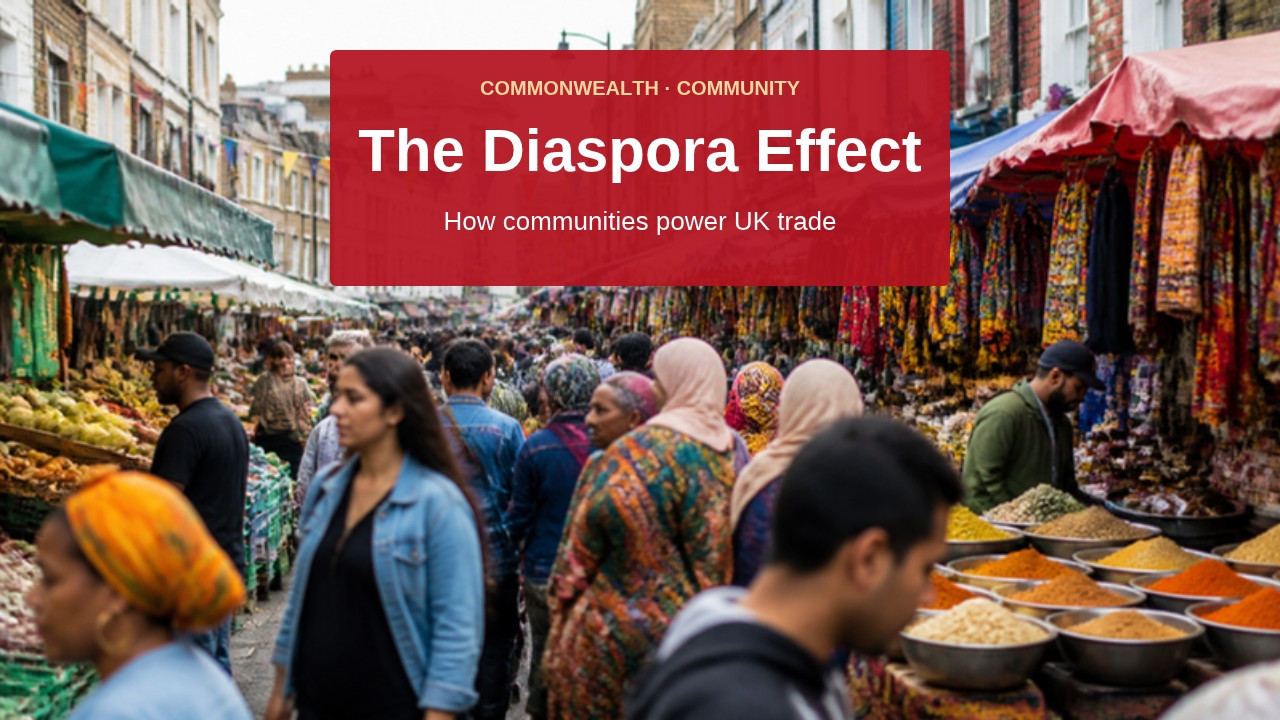
In short: Diaspora communities give the UK something trade deals cannot: people who understand both markets, speak the languages and are trusted on both sides. The 2021 Census recorded around 1.86 million people of Indian heritage in England and Wales, alongside large Bangladeshi, African, Caribbean and other Commonwealth communities. Their networks quietly lower the cost of doing business across the Commonwealth.
Trade is usually discussed in terms of tariffs, quotas and treaties. But anyone who has helped a business enter a new market knows the decisive factor is often simpler: who do you know, and do they trust you? That is where diaspora communities make the difference.
How big are the UK’s Commonwealth diaspora communities?
According to the 2021 Census for England and Wales, people of Indian heritage numbered around 1.86 million (3.1% of the population), Bangladeshi around 645,000, Black African around 1.49 million and Black Caribbean around 623,000. Many more have roots in Sri Lanka, Nigeria, Ghana, Kenya, Malaysia, Singapore and beyond.
How did these communities come to Britain?
The story of Britain’s Commonwealth communities is, in large part, the story of post-war Britain. When the HMT Empire Windrush docked at Tilbury on 22 June 1948, carrying passengers from the Caribbean who had come to help rebuild the country, it marked the start of a generation of migration that reshaped British life. That date is now marked each year as Windrush Day.
Migration from India and other parts of South Asia grew through the 1950s and 1960s, often to fill labour shortages in textiles, manufacturing and transport. In the late 1960s and early 1970s, many people of Indian heritage arrived from East Africa — most famously in 1972, when tens of thousands of Ugandan Asians expelled by Idi Amin resettled in Britain. Many arrived with little but went on to build businesses in retail, pharmacy, wholesale, manufacturing and professional services, becoming one of the UK’s most entrepreneurial communities.
Migration from West Africa — particularly Nigeria and Ghana — and from other Commonwealth countries has grown steadily since, bringing new generations of professionals, students and entrepreneurs.
How do diaspora communities drive trade?
- Market knowledge: understanding of customers, culture, regulation and how business really gets done.
- Trust networks: family, community and alumni links that shorten the path to a first meeting and a first deal.
- Entrepreneurship: diaspora-led businesses that import, export and invest in both directions.
- Consumer demand: communities that create UK markets for products from home — and introduce them to the wider public.
- Capital flows: remittances and investment that support businesses and families across the Commonwealth.
How large are diaspora money flows?
Remittances — money sent home by people working abroad — are one of the most tangible economic links between the UK and Commonwealth countries. India has for years been the world’s largest recipient of remittances, receiving well over US$100 billion a year according to World Bank estimates, a share of it from the UK. For several smaller Commonwealth economies, remittances are equivalent to a significant proportion of national income.
These flows matter for business too. They fund homes, education and small enterprises, and they have driven innovation in cross-border payments, as fintech firms compete to make sending money faster and cheaper. Increasingly, diaspora capital also flows as investment rather than family support — into property, start-ups and listed companies in the countries of heritage.
Why are diaspora networks underused?
Too often, diaspora communities are seen through a cultural lens alone, rather than as economic partners. Business councils, chambers and community organisations do valuable work connecting firms with markets, but they are rarely built into mainstream trade strategy. Mainstream UK businesses, meanwhile, frequently overlook the expertise sitting inside their own workforce and supplier base.
How can businesses tap diaspora networks?
- Join business councils and chambers focused on specific Commonwealth markets.
- Ask your own team. Colleagues with roots in a target market often have insight no consultant can match.
- Attend community and cultural events — festivals and celebrations are where relationships begin.
- Partner with diaspora-led firms that already trade in both directions.

King Charles Voices ‘Profound Sorrow’ Over Slavery at CHOGM, Stops Short of Apology

Anyaoku, McKinnon and Sharma: The Secretaries-General Who Made Democracy the Commonwealth’s Test

CHOGM 2026: What Commonwealth Leaders Agreed in Antigua

Progress is Painfully Slow’: Rudolph Walker Discusses Equality for Black Actors in the Commonwealth

Vipul Jain to Be Honored at Rising Bharat Conclave 2024 in the House of Commons for Transforming Wealth Management in Tribal Communities

Commonwealth Nations Celebrate Unity and Progress Under ‘Together We Thrive’ Theme

-
 Community & Culture2 years ago
Progress is Painfully Slow’: Rudolph Walker Discusses Equality for Black Actors in the Commonwealth
-
 Community & Culture2 years ago
Vipul Jain to Be Honored at Rising Bharat Conclave 2024 in the House of Commons for Transforming Wealth Management in Tribal Communities
-
 News2 years ago
Commonwealth Nations Celebrate Unity and Progress Under ‘Together We Thrive’ Theme
-

 Community & Culture2 years ago
Sri Lanka to Host Malayalam Film Starring Mammootty and Mohanlal: A Cultural Collaboration in the Commonwealth
-

 News2 years ago
Harnessing AI for Sustainable Tourism Growth in Zimbabwe: A Commonwealth Initiative
-

 Education2 years ago
Dominican Chairman Oversees Caribbean Plant Health Directors Annual Meeting, Strengthening Commonwealth Agricultural Collaboration
-

 News2 years ago
BIMSTEC Summit 2025 Highlights Regional Cooperation Aligned with Commonwealth Development Goals
-

 News2 years ago
INS Talwar Docks in Mombasa, Strengthening Kenya-India Naval Collaboration as Part of Commonwealth Relations