
Community & Culture
Antigua and Barbuda to Host 2025 National Anti-GBV Walk on International Women’s Day, Strengthening Commonwealth Commitment Against Gender-Based Violence


Antigua and Barbuda will once again lead the charge against gender-based violence (GBV) with the 2025 edition of the Men & Women United: Stop Gender-Based Violence 5k Walk, set for March 8, 2025, at 2:00 pm. The walk, which coincides with International Women’s Day, will begin at the Botanical Gardens in St. John’s and is expected to gather even more participants than last year’s successful inaugural event, which saw over 1,000 people marching for change.
Organised by the Integrated Health Outreach Gender-Based Violence (IHO-GBV) Coalition, the event is a call to action for all residents of Antigua and Barbuda to stand united against sexual violence and GBV. This year, the IHO-GBV Coalition, in partnership with the Directorate of Gender Affairs (DoGA), the Equality Fund, and Global Affairs Canada, aims to more than double the participation from 2024, with a particular focus on increasing the involvement of men and boys in the fight against gender-based violence.
The walk is part of a broader initiative to raise awareness about the urgent need to eliminate sexual violence and gender inequality in the Caribbean. The strong turnout last year showed that there is a growing movement in the region committed to addressing these issues head-on and pushing for lasting societal change. In addition to the St. John’s event, a separate walk will be held in Barbuda on a date to be announced.
This event reflects Antigua and Barbuda’s ongoing commitment to the Commonwealth’s shared goals of promoting gender equality, protecting human rights, and ending violence against women and girls across its member nations.

Commonwealth
The Diaspora Effect: How Communities Power UK–Commonwealth Trade
Millions of Britons have roots across the Commonwealth. Their networks, knowledge and trust are among the UK’s most underused trade assets.

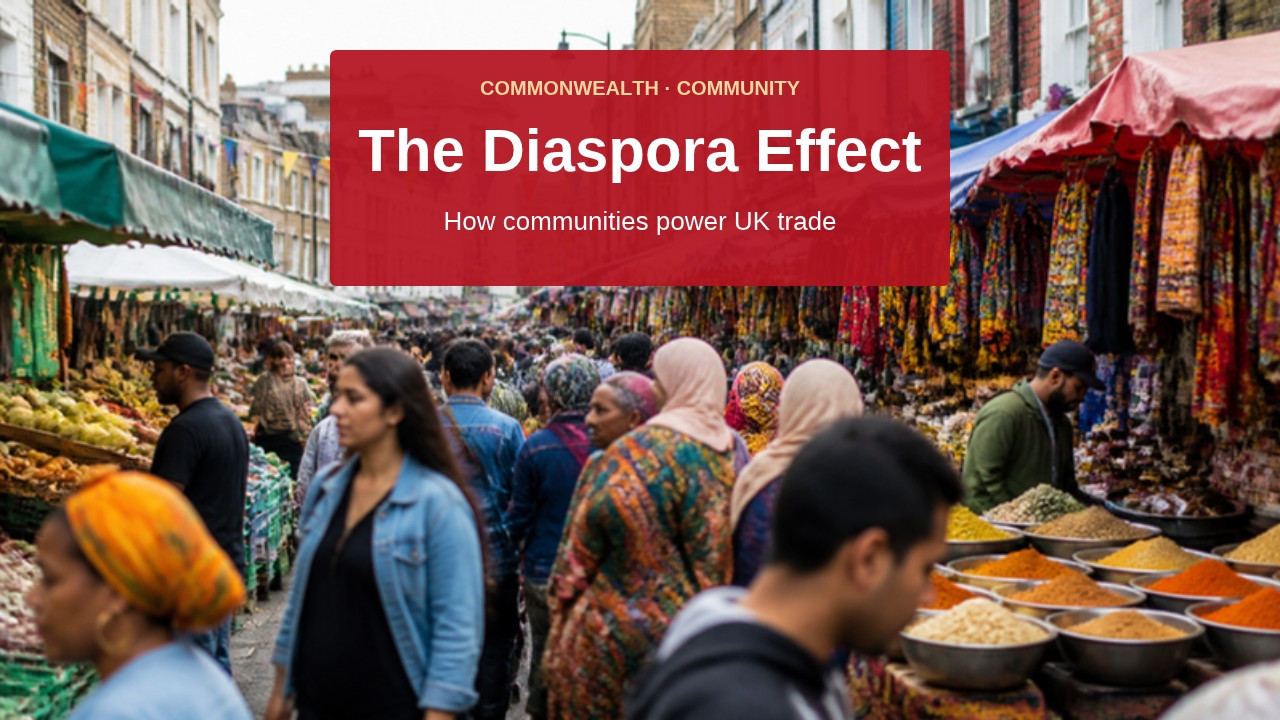
In short: Diaspora communities give the UK something trade deals cannot: people who understand both markets, speak the languages and are trusted on both sides. The 2021 Census recorded around 1.86 million people of Indian heritage in England and Wales, alongside large Bangladeshi, African, Caribbean and other Commonwealth communities. Their networks quietly lower the cost of doing business across the Commonwealth.
Trade is usually discussed in terms of tariffs, quotas and treaties. But anyone who has helped a business enter a new market knows the decisive factor is often simpler: who do you know, and do they trust you? That is where diaspora communities make the difference.
How big are the UK’s Commonwealth diaspora communities?
According to the 2021 Census for England and Wales, people of Indian heritage numbered around 1.86 million (3.1% of the population), Bangladeshi around 645,000, Black African around 1.49 million and Black Caribbean around 623,000. Many more have roots in Sri Lanka, Nigeria, Ghana, Kenya, Malaysia, Singapore and beyond.
How did these communities come to Britain?
The story of Britain’s Commonwealth communities is, in large part, the story of post-war Britain. When the HMT Empire Windrush docked at Tilbury on 22 June 1948, carrying passengers from the Caribbean who had come to help rebuild the country, it marked the start of a generation of migration that reshaped British life. That date is now marked each year as Windrush Day.
Migration from India and other parts of South Asia grew through the 1950s and 1960s, often to fill labour shortages in textiles, manufacturing and transport. In the late 1960s and early 1970s, many people of Indian heritage arrived from East Africa — most famously in 1972, when tens of thousands of Ugandan Asians expelled by Idi Amin resettled in Britain. Many arrived with little but went on to build businesses in retail, pharmacy, wholesale, manufacturing and professional services, becoming one of the UK’s most entrepreneurial communities.
Migration from West Africa — particularly Nigeria and Ghana — and from other Commonwealth countries has grown steadily since, bringing new generations of professionals, students and entrepreneurs.
How do diaspora communities drive trade?
- Market knowledge: understanding of customers, culture, regulation and how business really gets done.
- Trust networks: family, community and alumni links that shorten the path to a first meeting and a first deal.
- Entrepreneurship: diaspora-led businesses that import, export and invest in both directions.
- Consumer demand: communities that create UK markets for products from home — and introduce them to the wider public.
- Capital flows: remittances and investment that support businesses and families across the Commonwealth.
How large are diaspora money flows?
Remittances — money sent home by people working abroad — are one of the most tangible economic links between the UK and Commonwealth countries. India has for years been the world’s largest recipient of remittances, receiving well over US$100 billion a year according to World Bank estimates, a share of it from the UK. For several smaller Commonwealth economies, remittances are equivalent to a significant proportion of national income.
These flows matter for business too. They fund homes, education and small enterprises, and they have driven innovation in cross-border payments, as fintech firms compete to make sending money faster and cheaper. Increasingly, diaspora capital also flows as investment rather than family support — into property, start-ups and listed companies in the countries of heritage.
Why are diaspora networks underused?
Too often, diaspora communities are seen through a cultural lens alone, rather than as economic partners. Business councils, chambers and community organisations do valuable work connecting firms with markets, but they are rarely built into mainstream trade strategy. Mainstream UK businesses, meanwhile, frequently overlook the expertise sitting inside their own workforce and supplier base.
How can businesses tap diaspora networks?
- Join business councils and chambers focused on specific Commonwealth markets.
- Ask your own team. Colleagues with roots in a target market often have insight no consultant can match.
- Attend community and cultural events — festivals and celebrations are where relationships begin.
- Partner with diaspora-led firms that already trade in both directions.
Business
Diwali 2026: Why the Festival of Lights Is a Big Moment for UK Businesses
Diwali falls on Sunday 8 November 2026. For UK retailers, hospitality and service businesses, the Festival of Lights is one of the most important seasonal moments of the year — and one many still underestimate.
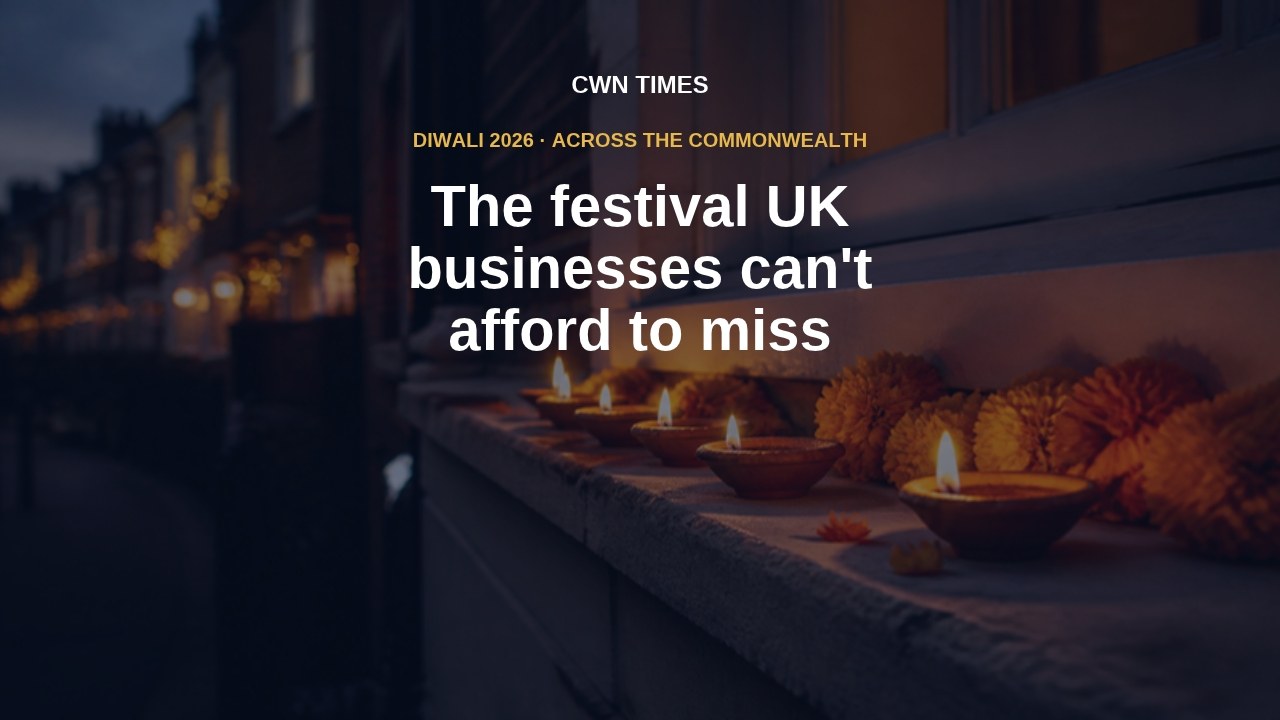
In short: Diwali 2026 falls on Sunday 8 November. Celebrated by Hindus, Sikhs and Jains, it is a season of gifting, new clothes, sweets, family gatherings and home spending — and for UK businesses it arrives just before the Christmas rush, making it one of the most valuable and most overlooked trading moments of the year.
For millions of British families, the weeks before Diwali are the busiest of the year. Homes are cleaned and decorated, gifts are bought for relatives and colleagues, new outfits are ordered and kitchens fill with sweets and savouries. From Leicester’s Belgrave Road — home to one of the largest Diwali celebrations outside India — to Southall, Wembley, Birmingham and Manchester, high streets light up for the festival.
Yet many UK businesses still plan their autumn around Halloween and Black Friday alone. That leaves real value on the table.
When is Diwali 2026?
Diwali itself falls on Sunday 8 November 2026, within a five-day festival that begins with Dhanteras — traditionally an auspicious day to buy gold, silver and household items — and ends with Bhai Dooj. For Sikhs, the same day marks Bandi Chhor Divas. Diwali is not a UK public holiday, so many families celebrate across the surrounding evenings and the weekend.
Why does Diwali matter for UK businesses?
The UK is home to one of the largest Indian diaspora communities in the world, and Diwali is the community’s biggest celebration of the year. Spending is concentrated in a short window and across several categories at once:
- Jewellery and gold — especially around Dhanteras
- Fashion — new outfits for family events and temple visits
- Food and sweets — mithai boxes, catering and restaurant bookings
- Gifting — hampers, homeware, electronics and corporate gifts
- Home and décor — lights, diyas, rangoli and home improvement
- Travel and hospitality — family visits and celebratory dining
Increasingly, mainstream brands and supermarkets run dedicated Diwali ranges, and more British businesses send Diwali greetings to clients and staff. Recognising the festival is no longer niche; it is part of good customer and employer relations in modern Britain.
How can small businesses make the most of Diwali?
- Plan early. Diwali shoppers buy in the two to three weeks before the festival. Stock, staffing and promotions need to be ready well before the day itself.
- Be authentic. Customers notice tokenism. Learn the basics — greetings such as “Happy Diwali” or “Shubh Deepavali”, what people buy and why — and involve staff or partners from the community.
- Make checkout effortless. Peak periods expose weak payment set-ups. Contactless, card-not-present and quick online checkout matter, as do clear delivery cut-off dates for gifts.
- Think gifting, not just discounts. Curated gift boxes, corporate hampers and gift cards often outperform price cuts during festive seasons.
- Connect Diwali to the wider season. Diwali leads naturally into Christmas trading. Customers who discover you in early November can become regulars through December.
Diwali across the Commonwealth
Diwali is a public holiday in several Commonwealth countries, including India, Singapore, Malaysia, Mauritius, Fiji, Guyana, Trinidad and Tobago, and Sri Lanka. For businesses that trade internationally, that matters: supply chains, customer service and payment volumes in these markets all shift around the festival — a useful reminder that cultural calendars are also business calendars.
The bottom line
Diwali is a reminder that Britain’s consumer calendar is more diverse than the traditional retail year suggests. Businesses that understand their communities — and plan for their celebrations as seriously as they plan for Christmas — earn loyalty that lasts well beyond one festive season.
Frequently asked questions
What date is Diwali in 2026 in the UK?
Diwali falls on Sunday 8 November 2026. It is part of a five-day festival that runs from Dhanteras to Bhai Dooj.
Is Diwali a bank holiday in the UK?
No. Diwali is not a public holiday in the UK, but it is widely celebrated, with major public events in cities such as Leicester, London and Birmingham.
How should a business wish customers Happy Diwali?
A simple “Happy Diwali” or “Wishing you a joyful Diwali” works well. Keep messages warm and genuine, and avoid using the festival only as a sales hook.
Related on CWN Times: CHOGM 2026 opens in Antigua with investment at the top of the agenda
Community & Culture
13-Year-Old Pune Girl’s Inspiring Writing Journey Explores Female Strength, Values and Inner Awareness

Anwita’s proposed book seeks to look at relationships and the experiences that shape young lives. Through her writing, she aims to explore how confidence, family support, friendship and trust can help young people understand themselves and navigate challenges.
An important part of Anwita’s personal journey is her daily practice of Sahaja Yoga meditation, following techniques taught by Her Holiness Shri Mataji Nirmala Devi, whom she deeply admires. She practices meditation regularly and is supported in this journey by her father, Atul Sharma, and mother, Barkha Sharma.
For Anwita, meditation and writing represent complementary ways of understanding life—one encouraging inner awareness and the other providing a means to express thoughts and observations about relationships and society.
Her proposed focus on female strength also connects with wider conversations about the aspirations, confidence and voices of girls and young women across Commonwealth societies. At the same time, her emphasis on family values and friendship reflects themes shared by communities across generations and cultures.
From a Commonwealth perspective, Anwita’s story represents the growing contribution of young voices to conversations about values, resilience, family relationships and social harmony. The Commonwealth brings together diverse societies, and young people like Anwita can contribute fresh perspectives shaped by their own cultural and personal experiences.
At 13, her journey is only beginning. Her proposed book could become an opportunity to share a young person’s perspective on how inner awareness, family support, trust, friendship and personal strength can influence the way the next generation views the world.

US$30bn of Projects and a New Trade Portal: CHOGM 2026’s Business Agenda

How to Set Up a UK Company from India: A Step-by-Step Guide

Commonwealth Welcomes UK Talks on Reparations: What the Antigua Dialogue Means

Progress is Painfully Slow’: Rudolph Walker Discusses Equality for Black Actors in the Commonwealth

Vipul Jain to Be Honored at Rising Bharat Conclave 2024 in the House of Commons for Transforming Wealth Management in Tribal Communities

Commonwealth Nations Celebrate Unity and Progress Under ‘Together We Thrive’ Theme

-
 Community & Culture2 years ago
Progress is Painfully Slow’: Rudolph Walker Discusses Equality for Black Actors in the Commonwealth
-
 Community & Culture2 years ago
Vipul Jain to Be Honored at Rising Bharat Conclave 2024 in the House of Commons for Transforming Wealth Management in Tribal Communities
-
 News2 years ago
Commonwealth Nations Celebrate Unity and Progress Under ‘Together We Thrive’ Theme
-

 Community & Culture2 years ago
Sri Lanka to Host Malayalam Film Starring Mammootty and Mohanlal: A Cultural Collaboration in the Commonwealth
-

 News2 years ago
BIMSTEC Summit 2025 Highlights Regional Cooperation Aligned with Commonwealth Development Goals
-

 News2 years ago
Harnessing AI for Sustainable Tourism Growth in Zimbabwe: A Commonwealth Initiative
-

 Education2 years ago
Dominican Chairman Oversees Caribbean Plant Health Directors Annual Meeting, Strengthening Commonwealth Agricultural Collaboration
-

 News2 years ago
INS Talwar Docks in Mombasa, Strengthening Kenya-India Naval Collaboration as Part of Commonwealth Relations